
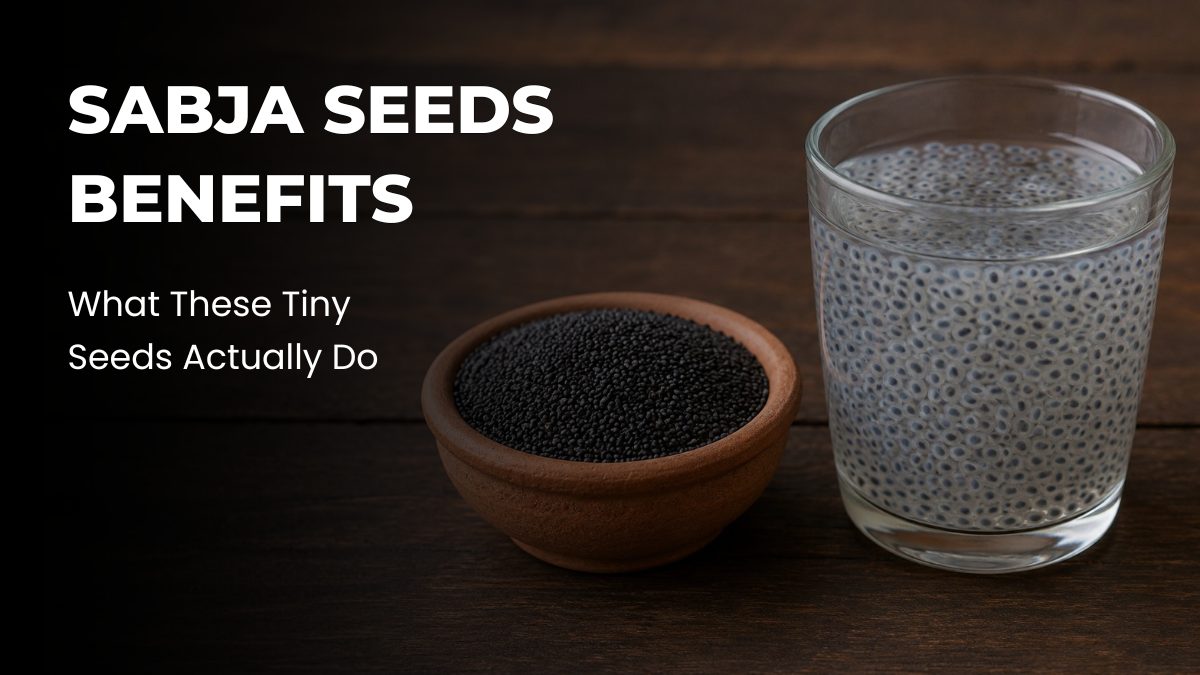
Drop two teaspoons of sabja seeds into a glass of water. Within five minutes, each tiny black seed swells to roughly 45 times its original size, surrounded by a clear gel coating that looks like a miniature version of a tapioca pearl. That gel is not decoration — it is soluble fibre, and it is doing more work in your gut than most supplements you would pay ten times the price for. Indians have been putting these seeds into falooda, sharbat, and rose milk for centuries, mostly for the texture. The nutrition case for doing it is even stronger than the tradition.
Quick Answer: Sabja seeds — called basil seeds in English, sabja ke beej in Hindi, and sabja ginjalu in Telugu — come from sweet basil (Ocimum basilicum). They are not the same as chia seeds, though they behave similarly when soaked. Per tablespoon (approximately 13g), sabja seeds provide around 7g of fibre, 2.5g of omega-3 fatty acids, 15% of your daily calcium requirement, and iron. Research on their component nutrients suggests they support digestion, blood sugar regulation, weight management, and body cooling — particularly relevant during Indian summers.
Sabja Seeds in English — and Why People Keep Confusing Them with Chia
Sabja seeds in English are called sweet basil seeds or simply basil seeds. The plant they come from — Ocimum basilicum — is the same species as the basil used in Italian cooking, but the seeds are edible and nutritionally distinct from the leaves. In South India they are called sabja ginjalu (Telugu) or sabja vithai (Tamil). In North India, sabja ke beej. In Maharashtra, tukmariya. In most of the rest of the world, they show up in Southeast Asian drinks and desserts under various names.
The chia confusion is understandable — both seeds are small, both swell in water, both form a gel coating. But they are different plants and they behave differently. Sabja seeds swell faster — within 5 minutes versus 20–30 minutes for chia. They swell larger — sabja expands to roughly 45 times its size; chia reaches about 10 times. Sabja seeds must be soaked before eating — swallowing them dry is not recommended, and unlike chia, they do not have a pleasant dry texture. And sabja has a longer Indian culinary history, which matters for the context in which you are likely to use them.
What Happens in Your Body When You Eat Soaked Sabja Seeds
The gel that forms around soaked sabja seeds is made of soluble fibre — specifically a mucilaginous polysaccharide that resists digestion in your small intestine and reaches your colon intact. What happens there is worth understanding specifically.
Your gut slows down — in a useful way. The gel coating slows the rate at which food moves through your digestive tract. This means glucose from your meal enters your bloodstream more slowly, producing a flatter blood sugar curve. A study published in the Journal of Food Science and Technology found that basil seed mucilage significantly reduced postprandial blood glucose response. For anyone managing blood sugar — or simply trying to avoid the 3pm energy crash — adding sabja seeds to a meal or drink before eating is a structural intervention, not a superfood trend.
You stay full longer. Soluble fibre absorbs water and expands in your stomach, physically increasing the volume of gut contents without adding calories. The seeds themselves are low calorie — roughly 60–65 kcal per tablespoon. You are trading a small number of calories for a disproportionately large satiety signal. This is the mechanism behind sabja seeds' association with weight management, and it is straightforward physics, not marketing.
Your gut bacteria get fed. The mucilage in sabja seeds functions as a prebiotic — it passes undigested to the colon where beneficial bacteria ferment it. Research consistently shows that prebiotic fibre supports gut microbiome diversity, reduces inflammation, and improves bowel regularity. This is the same mechanism behind isabgol (psyllium husk) — sabja delivers a similar benefit in a more palatable format.
Your body cools down — and there is a reason. The hydration effect is real. Each soaked seed carries a small amount of water in its gel coating, which releases slowly through digestion. Combined with the fibre's water-retention properties in the gut, this helps maintain hydration longer than drinking plain water. The traditional use of sabja in summer sharbats across India is not coincidence — it was functional cooling before anyone called it that.
The Omega-3 Case — and Why It Matters for Vegetarians
Sabja seeds contain approximately 2.5g of alpha-linolenic acid (ALA) — a plant-based omega-3 fatty acid — per tablespoon. That is comparable to flaxseeds and significantly more than chia seeds by weight. For vegetarians who do not eat fish, sabja seeds represent one of the most accessible omega-3 sources in the Indian diet, at a cost far below flaxseed oil supplements.
One important clarification: ALA must be converted by the body into EPA and DHA — the omega-3 forms with the strongest cardiovascular and neurological evidence. This conversion is inefficient in most people, typically 5–15%. Sabja seeds are not a substitute for fish oil if you have a specific clinical need. But as a daily dietary source of ALA for general cardiovascular support in a predominantly vegetarian diet, they deliver meaningfully with almost no effort — two teaspoons stirred into your morning nimbu pani.
Iron and Calcium — the Numbers That Deserve More Attention
One tablespoon of sabja seeds provides approximately 15% of the daily calcium requirement for an adult — which puts it in the same conversation as dairy for a plant-based calcium source. For anyone avoiding dairy, this is a practical addition to the daily calcium total that requires no preparation beyond soaking.
Iron content is approximately 3–4mg per tablespoon — a meaningful contribution toward the ICMR-recommended 17mg daily for adult women and 9mg for adult men. As with all plant iron, absorption improves significantly with vitamin C. Squeezing lemon into your sabja sharbat is not just for taste — it is the same principle as the lemon in sattu sharbat, and it doubles the effective iron absorbed. For a broader picture of plant-based nutrients in the Indian diet, the ICMR-NIN Dietary Guidelines for Indians 2024 (PDF) covers daily requirements for calcium, iron, and omega-3 in detail.
How to Actually Eat Sabja Seeds — and What Most People Get Wrong
The single most common mistake: not soaking long enough. Five minutes produces a partial gel. Fifteen minutes produces full swelling and the smooth, consistent texture that makes sabja pleasant to drink. Thirty minutes is ideal if you are adding them to a thick drink or dessert. Swallowing unsoaked sabja seeds is not dangerous for most healthy adults, but it bypasses the gel formation that delivers most of the digestive benefit — and risks choking if you are not careful.
Use cold or room-temperature water for soaking, not boiling. Heat disrupts the mucilage formation. The ratio is roughly one teaspoon of seeds to half a cup of water — they will absorb what they need and the rest stays as liquid in your drink.
Sabja sharbat — the simplest daily format: One teaspoon of seeds soaked in half a cup of water for 15 minutes. Add to a glass of cold water or nimbu pani with lemon, a pinch of kala namak, and optionally rose syrup (rooh afza — the traditional pairing) or kokum water. This is the version Bihar, UP, and Maharashtra have been drinking through summers for generations. It takes four minutes including soaking time.
Falooda — the dessert format: Soaked sabja seeds in chilled rose milk with thin vermicelli and a scoop of vanilla ice cream. Sabja seeds are the ingredient that makes falooda falooda — the texture is the point, and it happens to come with all the nutritional benefits above. Mumbai's street stalls serve millions of these every summer not because they calculated the omega-3 content but because it works.
Overnight oats or yogurt bowls: One teaspoon of sabja seeds mixed into overnight oats or plain curd. They soak overnight and add fibre and a subtle texture contrast by morning. No flavour impact — sabja seeds are almost completely neutral in taste. This is the easiest format for people who want the nutritional benefit without making a drink.
Summer drinks and kokum sharbat: Add soaked sabja seeds to any cold drink — coconut water, kokum sharbat, aam panna, jaljeera. They complement tart and tangy flavours particularly well, and the gel coating makes every sip slightly more substantial and hydrating.
Sabja Seeds vs Chia Seeds — Which One Should You Actually Buy?
This question comes up constantly because they look similar and the internet treats them as interchangeable. They are not identical, and the right answer depends on what you are trying to do.
If you want the fastest hydration and cooling effect — sabja. It swells in 5 minutes, chia takes 20–30. For summer drinks, sabja is more practical. If you want to eat seeds dry — chia. Sabja seeds eaten dry have an unpleasant texture and skip the gel formation that delivers most of the benefit. If you are primarily after omega-3 — both are comparable, but flaxseeds have stronger evidence for cardiovascular ALA benefits if that is your specific goal. If you are looking for an affordable option widely available in India — sabja wins clearly. It costs a fraction of chia seeds, grows across the subcontinent, and has been used in Indian kitchens for centuries before chia became an import trend. For general daily use in an Indian diet, sabja is the more natural and practical choice.
What to Check Before Buying Sabja Seeds
The market for sabja seeds in India is relatively clean compared to other superfoods — adulteration is less common than with something like ashwagandha powder or sattu. But there are still two things worth checking.
Swelling test: Good sabja seeds swell uniformly and quickly — all seeds should reach full gel coating within 15 minutes. If a significant proportion of seeds do not swell, or swell unevenly, the seeds are old or improperly stored. Freshness directly affects the mucilage content and therefore the fibre benefit.
Colour and uniformity: Genuine sabja seeds are jet black, small, and uniform in size. Significantly varying sizes or seeds with any brown or grey discolouration indicate old stock or mixing with inferior seeds. The seeds should have no smell — any musty or fermented odour means moisture damage.
Organic certification: For certified organic sabja seeds — meaning grown without synthetic pesticides — look for the Jaivik Bharat or India Organic logo on the packaging. PureStora carries Ecotyl Basil Seeds (Sabja Seeds) 250g — verified before listing, no fillers. Browse the full Health & Wellness range for other certified options. For how to read organic certification marks in general, see our post on Ayurvedic superfoods and how to verify what you are buying.
Frequently Asked Questions
What are sabja seeds called in English?
Sabja seeds in English are called sweet basil seeds or basil seeds. They come from Ocimum basilicum — the same plant species as cooking basil, but the seeds are eaten rather than the leaves. In Telugu they are sabja ginjalu, in Tamil sabja vithai, in Hindi sabja ke beej or tukmariya. They are not the same as chia seeds, though both form a gel when soaked in water.
What are the benefits of eating sabja seeds daily?
Daily consumption of 1–2 teaspoons of soaked sabja seeds contributes soluble fibre for digestion and blood sugar regulation, omega-3 fatty acids (ALA) for cardiovascular health, calcium, and iron. Research on the component nutrients supports improved satiety, slower glucose absorption, and gut microbiome support. Most healthy adults can consume them daily. People on blood thinners should consult a doctor first, as omega-3 fatty acids can have mild anticoagulant effects.
Do sabja seeds help with weight loss?
The mechanism is real: soaked sabja seeds expand in the stomach, increase satiety, and deliver fibre that slows glucose absorption — all of which support reduced overall calorie intake. They are not a weight-loss product and there are no clinical trials specifically on sabja seeds and body weight. But replacing a high-calorie snack or sweetened drink with a sabja sharbat is a straightforward dietary improvement. At roughly 60–65 kcal per tablespoon, the calorie cost is low relative to the satiety effect.
Can I eat sabja seeds without soaking?
It is not recommended. Unsoaked sabja seeds skip the gel formation that delivers most of the digestive fibre benefit. They also have an unpleasant dry texture and create a choking risk if swallowed quickly. Always soak in water for at least 15 minutes before consuming. Unlike chia seeds, sabja seeds are not designed to be eaten dry.
What is the difference between sabja seeds and chia seeds?
Both swell in water and form a gel coating, but they come from different plants and behave differently. Sabja swells faster (5 minutes vs 20–30 for chia) and larger (45x vs 10x original size). Sabja must be soaked; chia can be eaten dry. Sabja is significantly cheaper in India and has a longer Indian culinary history. Both offer comparable omega-3 and fibre per serving. For Indian diets and summer drinks specifically, sabja is more practical and more affordable.
Are sabja seeds safe during pregnancy?
There is limited clinical research on sabja seed consumption specifically during pregnancy. The seeds have a long history of culinary use in India in normal dietary amounts — small quantities in falooda or sharbat are generally considered safe. However, medicinal quantities or supplements should not be consumed during pregnancy without consulting a doctor. The same applies to any concentrated food supplement.
Conclusion
Sabja seeds have been in Indian kitchens for centuries — in falooda, in rose sharbat, in summer drinks across every region. The fact that they also deliver fibre, omega-3, calcium, and iron in a format that takes five minutes to prepare is either a happy coincidence or evidence that traditional food knowledge works. The only variable when buying is freshness — seeds that swell uniformly and completely are seeds that are delivering the benefit you are paying for. For certified organic sabja seeds with verified sourcing, browse PureStora's Health & Wellness range. For other Ayurvedic seeds and superfoods with similar profiles, see our guide on ragi benefits — another ingredient with centuries of Indian use and a strong modern nutritional case.
Disclaimer: This article is for general informational purposes only and is not a substitute for medical, nutritional, or professional advice. Nutritional values are approximate and may vary by variety and processing method. Consult a qualified healthcare provider before making significant dietary changes.
