
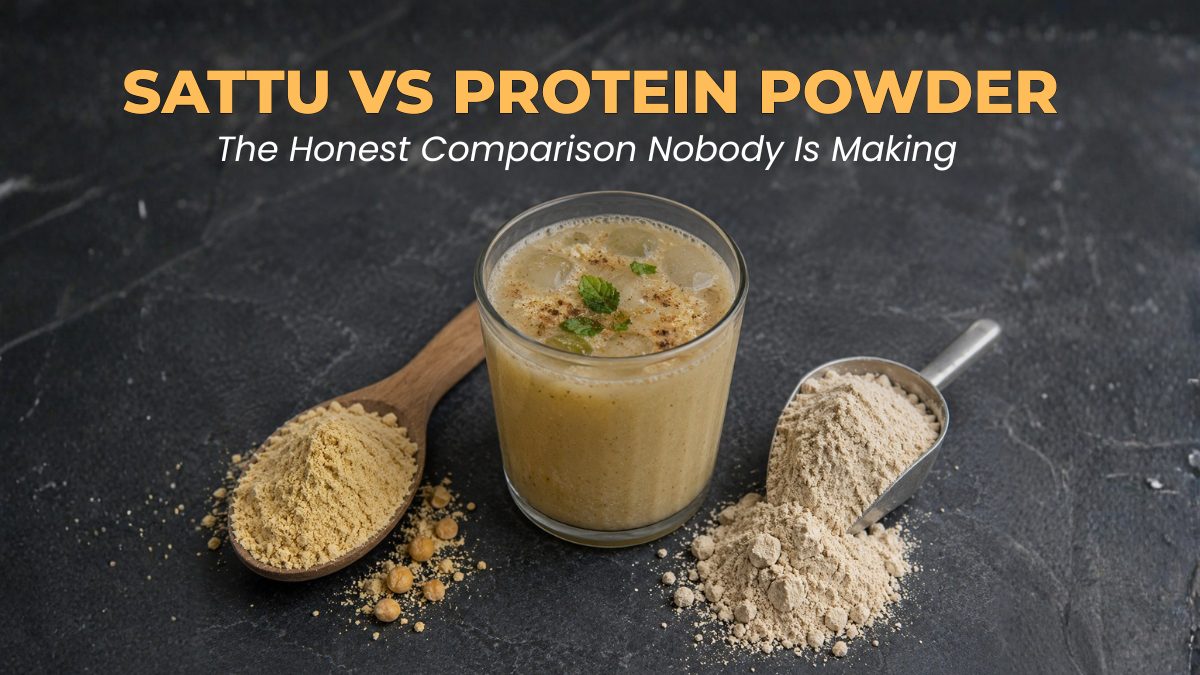
The Indian fitness supplement market crossed ₹10,000 crore in 2024. A significant portion of that is people buying whey protein tubs at ₹3,000–6,000 each to hit protein targets that a glass of sattu sharbat in the morning, a bowl of sprouted chana at lunch, and a double serving of dal at dinner would also hit — for roughly ₹30 a day. That is not an argument against protein powder. It is an argument for understanding what each one actually does and what you actually need before spending money on a supplement.
Quick Answer: Sattu (roasted Bengal gram flour) contains 20–25g of protein per 100g, 8–12g of fibre, iron, magnesium, and a low glycaemic index. It is a whole food. Protein powder — specifically whey, pea, or soy isolate — contains 70–85g of protein per 100g with minimal fibre or micronutrients. It is a concentrated supplement. They solve different problems. Sattu is a daily dietary staple that closes general protein and micronutrient gaps for most Indian vegetarians. Protein powder is a targeted tool for people with specific high-protein requirements — athletes, bodybuilders, people recovering from injury — who cannot meet those requirements through food alone.
The Protein Numbers — and Why Concentration Is Not the Only Thing That Matters
Whey protein isolate delivers approximately 80–85g of protein per 100g. Sattu delivers approximately 20–25g per 100g. On pure protein concentration, it is not a close comparison. Protein powder wins by a factor of three to four.
But this is where most comparisons stop, and where they start misleading people. Protein concentration per 100g is a laboratory measurement. What matters for daily nutrition is protein per serving in the format you actually consume, the cost of that protein, and what else comes with it.
A standard 35g serving of sattu in a morning drink delivers 7–9g of protein, 3–4g of fibre, iron, magnesium, calcium, and complex carbohydrates that sustain energy for hours. The same weight in whey protein isolate delivers 28–30g of protein, near-zero fibre, and minimal micronutrients — plus whatever sweeteners, emulsifiers, and flavouring agents the manufacturer added. Neither is better in absolute terms. They are doing different jobs in your body.
For a 60kg person who needs 60g of protein daily, a realistic daily diet of two large katoris of dal (24–30g), a glass of sattu sharbat (7–9g), a bowl of sprouted chana (8–10g), and a serving of paneer or tofu covers the requirement without any supplement. Protein powder becomes relevant when this dietary approach fails — either because the person's protein requirement is higher (serious athletes need 1.6–2.2g per kg, not 0.83g), or because lifestyle and schedule make consistent whole-food protein difficult.
The Fibre Difference — Why It Matters More Than People Realise
This is the comparison that never gets made in supplement marketing, because supplement marketing has no incentive to make it. Whey protein isolate contains essentially zero dietary fibre. A 35g serving of sattu contains 3–4g of fibre — a meaningful contribution toward the 25g daily target that most Indian urban diets fall well short of.
Fibre does things protein cannot: it feeds gut bacteria, slows glucose absorption, improves bowel regularity, and creates satiety that lasts for hours rather than a short post-meal window. The reason sattu has sustained Bihar's physically demanding farming population for generations is not just the protein — it is the combination of protein, fibre, and low glycaemic complex carbohydrates that produces sustained energy without a crash. A whey shake delivers a rapid protein spike and little else. Both have their place. But for an Indian vegetarian whose primary goals are daily energy, gut health, and general protein adequacy — sattu is the more complete dietary tool.
What the Research Now Says About Plant Protein for Muscle Building
The conventional wisdom that whey protein is categorically superior to plant protein for muscle building has shifted significantly in recent research. A 2024 study published in Medicine & Science in Sports & Exercise and indexed on PubMed Central found that plant protein blend ingestion stimulated post-exercise muscle protein synthesis rates equivalently to whey in resistance-trained adults. This is not an isolated finding — 75% of studies in a 2025 systematic review found no significant difference in muscle protein synthesis between plant and animal proteins at equivalent doses.
The important nuance: this applies to plant protein blends and isolates — specifically pea protein, soy protein, and rice-pea combinations — not to sattu specifically. Sattu is an incomplete protein — it does not contain all nine essential amino acids in optimal ratios. Lysine is adequate; methionine is the limiting amino acid. For serious muscle building where the post-workout anabolic window matters, a plant protein isolate (pea, soy) is closer to whey than sattu is.
What this means practically: the gap between whey and a quality plant protein isolate is now small and mostly irrelevant for most people. The gap between sattu and whey is real for targeted muscle building purposes — but for general daily protein adequacy, sattu closes the gap in a way that serves the whole body rather than just muscle protein synthesis.
Cost — the Number That Changes the Conversation
A 1kg bag of quality sattu costs ₹80–150 in India. That delivers 200–250g of protein across its 40–50 servings. Cost per gram of protein: approximately ₹0.5–0.7.
A 1kg tub of whey protein isolate costs ₹3,000–6,000 in India depending on brand. That delivers 800–850g of protein across 30–40 servings. Cost per gram of protein: approximately ₹4–8.
Whey protein costs roughly 8–12 times more per gram of protein than sattu. For someone who genuinely needs the higher protein concentration and faster absorption of whey — a competitive athlete, a bodybuilder in a structured program, someone recovering from surgery — that premium is worth paying. For someone who just wants to eat more protein as part of a generally healthier diet, it is a significant overpayment for a marginal benefit.
Plant protein isolates (pea, soy) are cheaper than whey — typically ₹1,500–2,500 per kg — and based on recent research, produce equivalent muscle protein synthesis results. For vegetarians and vegans who want a concentrated protein supplement, plant isolates are now the more rational choice on both cost and ethics grounds. PureStora carries Pea Protein Isolate 450g and Soy Protein Isolate 450g by Plant Power — both verified before listing.
Who Should Use What — the Honest Decision Framework
Use sattu if: Your primary goal is daily protein adequacy as part of a generally healthy diet. You want fibre, iron, and sustained energy alongside protein. You are an Indian vegetarian eating mostly dal, roti, rice, and sabzi and want to close a moderate protein gap cost-effectively. You want a whole-food approach with no processing, no additives, and no supplements. For the full picture on how sattu works and how to make sattu sharbat, see our post on sattu benefits and protein content. For certified organic sattu, PureStora carries Sattu Flour 1kg by The MMasala Box Co.
Use plant protein isolate if: You train seriously — 4 or more sessions per week — and have a specific protein target of 1.6g per kg or above. You want a convenient post-workout shake that delivers concentrated protein quickly. You are struggling to hit protein targets through food alone despite eating well. You want the muscle-building benefits of concentrated protein without dairy (pea protein is the closest plant equivalent to whey in terms of amino acid profile and absorption speed).
Use whey protein if: All of the above apply and you are not vegetarian or vegan and have no lactose intolerance. Whey still has a marginal advantage in the 30–60 minute post-workout window specifically due to leucine content and absorption speed — but the gap to plant protein isolates is now small enough that it is not a compelling reason for Indian vegetarians to choose whey over pea or soy protein.
Use both sattu and protein powder if: You are a serious vegetarian athlete. Sattu in the morning provides sustained energy, fibre, and general protein. A plant protein shake post-workout provides the rapid amino acid delivery that matters for muscle recovery. The two serve different windows and different purposes — they complement rather than compete.
The Additive Problem — What Protein Powder Labels Don't Tell You
This is a comparison point that almost never appears in supplement marketing. Commercial whey protein products frequently contain artificial sweeteners (sucralose, acesulfame potassium), emulsifiers (sunflower lecithin, soy lecithin), flavouring agents, and in some cases heavy metal contamination from the filtration process. A 2018 Clean Label Project analysis found measurable levels of arsenic, cadmium, and lead in multiple popular protein powders — though levels were generally below regulatory limits.
Sattu contains one ingredient: roasted Bengal gram. Or two, if barley is included. No sweeteners, no emulsifiers, no flavouring, no processing beyond roasting and grinding. For consumers who prioritise clean labels — which PureStora's entire positioning is built around — this distinction matters. The supplement industry's "natural" and "clean" labelling is largely unregulated. A tub of whey with "natural flavours" on the label may contain dozens of synthetic compounds. Sattu's ingredient list is verifiable in a way that no commercial protein powder's is.
Frequently Asked Questions
Is sattu better than protein powder for muscle building?
For serious muscle building — training 4+ times per week with a protein target above 1.6g per kg — a plant protein isolate is more targeted than sattu. Sattu is an incomplete protein with lower concentration per serving. Plant protein isolates (pea, soy) now produce muscle protein synthesis results equivalent to whey in research. For general daily protein adequacy without a specific muscle-building program, sattu is the more practical and complete dietary choice — it delivers protein alongside fibre, iron, and sustained energy that a protein shake does not.
Can I use sattu as a pre-workout drink?
Yes — sattu sharbat 30–45 minutes before exercise is a traditional and effective pre-workout format. The low glycaemic index complex carbohydrates provide sustained energy through a workout without a mid-session crash. The protein contributes to muscle protein availability. It is not optimal for rapid post-workout recovery in the same way a fast-digesting protein isolate is — for that, a pea or soy protein shake is more targeted. But as a pre-workout energy and protein source for moderate exercise, sattu works well and costs a fraction of commercial pre-workout supplements.
How much protein does sattu have compared to whey?
Sattu contains 20–25g of protein per 100g dry weight. Whey protein isolate contains 80–85g per 100g. A standard 35g serving of sattu delivers 7–9g of protein. A standard 30g serving of whey delivers 24–26g. Whey provides roughly three times the protein per serving. The trade-off is that sattu also delivers 3–4g of fibre, iron, magnesium, and slow-digesting carbohydrates per serving — nutrients that whey does not provide. For more on protein-rich vegetarian foods in the Indian diet, see our guide on protein rich food for vegetarians in India.
Is sattu good for weight loss or weight gain?
Sattu supports both goals depending on how it is used. For weight management: the high fibre content increases satiety, slows glucose absorption, and helps reduce overall calorie intake — most people who replace a refined-carb breakfast with sattu sharbat notice reduced hunger through the morning. At roughly 110–120 kcal per 30g serving, it is also calorie-efficient relative to its nutritional density. For weight gain: sattu can be consumed in larger quantities — sattu laddoos with jaggery and ghee, sattu paratha — to increase caloric and protein intake in a whole-food format. It is more versatile across both goals than a protein supplement, which is purely a protein delivery mechanism.
Which is better — pea protein or whey protein for vegetarians?
Research published in 2024 found that plant protein blends — including pea protein — produce muscle protein synthesis responses equivalent to whey at equivalent doses. For vegetarians, pea protein isolate is the most rational concentrated protein supplement: it avoids dairy, has a good amino acid profile (complete with adequate leucine when consumed at higher doses), digests well without the digestive discomfort some people experience with whey, and costs less than premium whey. Soy protein isolate is the other strong option — slightly more complete amino acid profile than pea, though concerns about soy and hormones are overstated in research. PureStora carries both Pea Protein Isolate and Soy Protein Isolate for verified plant protein options.
Conclusion
The sattu vs protein powder comparison resolves simply once you separate what each one does. Sattu is a whole food — protein, fibre, iron, and sustained energy in a format that costs ₹80 a kilo, has no additives, and has been validated by centuries of daily use by physically demanding populations. Protein powder is a concentrated supplement — maximum protein per gram, fast absorption, useful for specific high-protein requirements that whole foods alone cannot efficiently meet. Most Indian vegetarians do not need protein powder. They need more sattu, more dal, and more sprouted pulses. Some do need a supplement — particularly serious athletes with protein targets above 1.6g per kg. For them, a plant protein isolate now makes as much sense as whey, at lower cost and without dairy. For verified options across both whole-food protein sources and plant protein isolates, browse PureStora's Health & Wellness range and Food & Beverages range.
Disclaimer: This article is for general informational purposes only and is not a substitute for medical or nutritional advice. Nutritional values are approximate and may vary by brand and processing method. Consult a qualified dietitian if you have specific protein requirements due to a health condition or athletic programme.
