
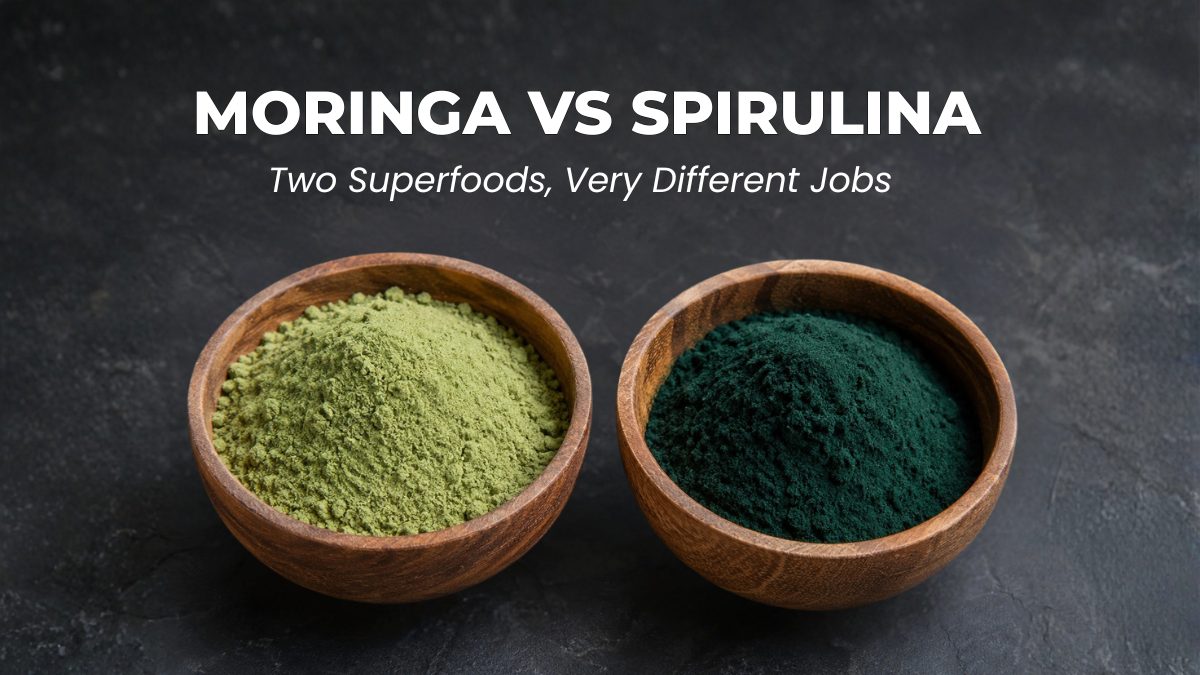
Moringa and spirulina show up together constantly — in health store shelves, in supplement stacks, in "what should I add to my morning drink" conversations. They are both green powders. They are both marketed as superfoods. And they are so nutritionally different that comparing them directly misses the point. Moringa is a tree leaf. Spirulina is a blue-green algae. One grows in Tamil Nadu and Andhra Pradesh and has been in Indian cooking for generations. The other is cultivated in freshwater tanks and produces more complete protein per gram than most animal foods. They do not compete with each other — they solve different nutritional problems.
Quick Answer: Moringa (Moringa oleifera) is primarily a micronutrient powerhouse — exceptionally high in iron, calcium, vitamin C, vitamin A, and B vitamins from a plant source. It is more food than supplement, suited to daily dietary use for micronutrient gaps. Spirulina is primarily a protein and phycocyanin source — 55–70% complete protein by dry weight, with all nine essential amino acids, making it one of the most protein-dense foods on earth. It also provides iron and B12 precursors. The choice between them depends on what you are short on: micronutrients point toward moringa, protein and complete amino acids point toward spirulina. Both together is a reasonable daily habit for most Indian vegetarians.
What Moringa Actually Is — and Why It Belongs in an Indian Kitchen
Moringa oleifera is a tree, not an imported health trend. The drumstick tree — known as sahjan in Hindi, murungai in Tamil, and munagakaya in Telugu — grows across tropical India. The drumstick vegetable (the long seed pods) has been in South Indian cooking for centuries. What changed recently is the use of the dried, powdered leaves — moringa leaf powder — as a concentrated nutritional supplement.
The leaves of Moringa oleifera are nutritionally dense in a way that few plant foods match. Dry moringa leaf powder contains approximately 25–27g of protein per 100g, 28mg of iron per 100g (roughly 9 times the iron in an equivalent weight of spinach), 2,000mg of calcium per 100g, and significant quantities of vitamins A, C, E, and multiple B vitamins. The vitamin C content specifically matters for iron absorption — the combination of high iron and high vitamin C in the same food is one of moringa's most practical nutritional advantages.
The serving size in practice is 5–10g (one to two teaspoons) — which delivers 1–2g of protein, approximately 1.5mg of iron, and meaningful vitamin contributions to a daily diet. Moringa is not a protein strategy at these serving sizes. It is a micronutrient strategy — the best way to think about it is as a whole-food multivitamin that grows on a tree that is native to India.
What Spirulina Actually Is — and Why the Protein Number Matters
Spirulina is a blue-green microalgae — specifically Arthrospira platensis — cultivated in freshwater or controlled alkaline water environments. It is not a plant in the conventional sense. It is one of the oldest life forms on earth, and gram for gram, one of the most nutritionally concentrated foods ever studied.
The defining characteristic is protein. A comprehensive review published in Nutrients journal (PMC, 2024) confirmed spirulina's protein content at 55–70% of dry weight — and crucially, it is a complete protein, containing all nine essential amino acids. This is exceptional for a plant-derived food. Most plant proteins are incomplete — they lack one or more essential amino acids, which is why dal-roti combinations work better than dal alone. Spirulina requires no such combination. A single teaspoon (5g) delivers 3–4g of complete protein.
Beyond protein, spirulina contains phycocyanin — a blue pigment-protein complex unique to blue-green algae that has demonstrated anti-inflammatory and antioxidant properties in research. It also contains iron (approximately 28mg per 100g, comparable to moringa), B vitamins including B12 precursors (important for vegetarians), and gamma-linolenic acid (GLA), an omega-6 fatty acid with anti-inflammatory properties.
The practical limitation is taste. Spirulina has a strong, distinctly oceanic flavour that requires a carrier to make daily consumption tolerable. A glass of nimbu pani, a smoothie, or a strongly-flavoured chaas masks it effectively. Stirring it into plain water and drinking it without disguise is an experience most people do not repeat.
The Nutrition Comparison — Where Each One Wins
Protein: Spirulina wins clearly. 55–70g per 100g dry weight versus moringa's 25–27g. More importantly, spirulina's protein is complete — all nine essential amino acids. Moringa's protein is good but not complete in the same ratio. For vegetarians specifically trying to close a protein gap, spirulina is the more targeted tool.
Iron: Both are exceptional, and unusually equal here. Both moringa and spirulina contain approximately 28mg of iron per 100g dry weight. A 2021 randomised controlled trial published in BMC Nutrition found spirulina supplementation significantly improved haemoglobin levels and reduced iron deficiency anaemia in children — one of the cleaner human trials on spirulina's iron effect. Moringa's iron advantage over spirulina is that it comes packaged with vitamin C in the same food, which directly improves iron absorption. Spirulina requires an external vitamin C source for the same absorption benefit.
Vitamin C: Moringa wins decisively — approximately 220mg per 100g dry weight, one of the highest vitamin C concentrations in any dried plant food. Spirulina contains negligible vitamin C. This matters practically because vitamin C doubles the bioavailability of plant iron. Moringa powder in a drink with lemon is a self-contained iron-and-absorption system. Spirulina needs lemon added separately to achieve the same iron absorption effect.
Calcium: Moringa wins — approximately 2,000mg per 100g versus spirulina's 120mg per 100g. For bone health and calcium supplementation specifically, moringa is significantly more relevant.
Phycocyanin and anti-inflammatory compounds: Spirulina wins — this blue pigment complex is unique to blue-green algae and has no equivalent in moringa. Research on phycocyanin shows antioxidant and anti-inflammatory properties, immune modulation, and protective effects on liver and kidney cells. Moringa has its own antioxidant profile through flavonoids and polyphenols, but phycocyanin is structurally different and the research on it specifically is stronger.
Taste and daily usability: Moringa wins. Moringa powder has a mild, slightly grassy taste that blends neutrally into most drinks and foods. Spirulina has a strong oceanic taste that many people find unpleasant without a flavour carrier. Both can be added to morning drinks, but moringa requires less adaptation.
Who Should Use Which — the Honest Decision Framework
Use moringa if: Your primary concern is micronutrient gaps — specifically iron, calcium, vitamin A, or vitamin C. If you are a vegetarian woman concerned about anaemia, moringa with lemon in a morning drink is one of the most targeted dietary interventions available. If you want a whole-food supplement that fits easily into Indian cooking — moringa can go into dal, khichdi, roti dough, or chai without dramatically changing the taste. If you want something affordable and domestically produced in India.
Use spirulina if: Your primary concern is protein — specifically complete protein with all essential amino acids. If you are an athlete, a highly active person, or a strict vegetarian struggling to reach protein targets, spirulina's complete protein profile at 5g per teaspoon is the most efficient plant protein addition available. If you specifically want the phycocyanin anti-inflammatory benefit. If B12 precursor supplementation is relevant (important caveat: spirulina contains pseudovitamin B12 which may not be bioavailable — this is debated in research and spirulina should not replace true B12 supplementation for vegans).
Use both if: This is genuinely the most practical answer for most Indian vegetarians. Moringa covers micronutrients — iron, calcium, vitamin C, vitamin A. Spirulina covers complete protein and phycocyanin. They do not overlap significantly in their primary contributions. A morning drink containing both — one teaspoon of each in nimbu pani — delivers a broad micronutrient base alongside complete protein in 90 seconds. The flavour profiles complement rather than compete. PureStora carries Ecotyl Moringa Leaf Powder 150g and Spirulina Powder 100g by Bionode Organics — both certified and verified before listing. Browse the full Health & Wellness range for other certified superfood powders.
How to Take Them Together — and What to Avoid
The simplest daily format: one teaspoon each of moringa and spirulina powder in a glass of water or nimbu pani, stirred well, drunk in the morning. The lemon serves two functions — it masks spirulina's oceanic taste and provides vitamin C for iron absorption from both powders simultaneously. This is the most nutritionally efficient morning drink combination available to an Indian vegetarian, and it costs significantly less than any commercial superfood blend delivering comparable nutrition.
Start with half a teaspoon of spirulina if you are new to it — the taste is an acquired one and the full teaspoon can be unpleasant initially. Moringa can go at full dose from day one. Build up over a week to the full teaspoon of spirulina.
One thing to avoid: taking either powder with hot water or hot tea. Heat degrades vitamin C in moringa and denatures phycocyanin in spirulina — both of which are key active components. Room temperature or cool water preserves both. For more on how these superfoods fit into a broader Ayurvedic and plant-based approach to daily nutrition, see our guide on Ayurvedic superfoods and what the research actually says.
Frequently Asked Questions
Which is better — moringa or spirulina?
Neither is categorically better — they solve different nutritional problems. Moringa is better for micronutrient gaps: iron with built-in vitamin C for absorption, calcium, vitamin A, vitamin C. Spirulina is better for protein: 55–70% complete protein by dry weight with all nine essential amino acids, plus phycocyanin's anti-inflammatory properties. For most Indian vegetarians, using both together gives a more complete nutritional picture than choosing one over the other.
Can I take moringa and spirulina together?
Yes — they complement each other well. There is no known interaction between moringa and spirulina, and their nutritional profiles are largely non-overlapping. Moringa covers micronutrients; spirulina covers protein and phycocyanin. One teaspoon of each in a morning drink with lemon is a practical and nutritionally complete combination. Start with half a teaspoon of spirulina if you are new to it, as the taste takes adjustment.
Is moringa a good protein source?
Moringa contains 25–27g of protein per 100g dry weight — higher than most vegetables and comparable to some legumes. However, the practical serving size is 5–10g daily, which delivers only 1–2g of protein. Moringa is not meaningfully useful as a protein strategy at normal serving sizes. Its strength is micronutrients — iron, calcium, vitamins — not protein volume. For plant-based protein, spirulina, dal, chana, sattu, and quinoa are more targeted choices. See our guide on protein rich vegetarian food in India for the full picture.
Does spirulina have more iron than moringa?
No — they are roughly equal, both containing approximately 28mg of iron per 100g dry weight. The practical difference is absorption. Moringa contains significant vitamin C in the same food, which dramatically improves non-haem iron absorption. Spirulina does not contain meaningful vitamin C, so its iron is less bioavailable unless taken with a vitamin C source like lemon juice. For iron supplementation specifically, moringa with lemon in a morning drink is the more self-contained system.
Is spirulina safe to take daily?
Yes, at standard doses (1–3g daily) spirulina is considered safe for most healthy adults. Reported side effects are generally mild — nausea or digestive discomfort when starting, usually resolving within a week. People with phenylketonuria (PKU) should avoid it as spirulina contains phenylalanine. Those on blood thinners should consult a doctor — spirulina has mild anticoagulant properties. Important note on B12: spirulina contains pseudovitamin B12, which may not be bioavailable. Vegans and strict vegetarians should not rely on spirulina for B12 and should use a certified B12 supplement separately.
Conclusion
The moringa vs spirulina question has a straightforward answer once you separate what each one actually does. Moringa is a micronutrient delivery system — iron, calcium, vitamin C, vitamin A, in a whole-food format that grows in India and has been part of Indian cooking for centuries. Spirulina is a complete protein and phycocyanin source — the most protein-dense plant food available, with all nine essential amino acids, in a format that requires a flavour carrier but takes seconds to add to any drink. Most Indian vegetarians are short on both micronutrients and complete protein. Using both together in a morning drink is not doubling up — it is covering two distinct gaps with two distinct tools. For certified organic versions of both, browse PureStora's Health & Wellness range.
Disclaimer: This article is for general informational purposes only and is not a substitute for medical or nutritional advice. Nutritional values are approximate and may vary by variety, source, and processing method. Consult a qualified healthcare provider before adding supplements to your diet, particularly if you are managing a health condition or taking medication.
