
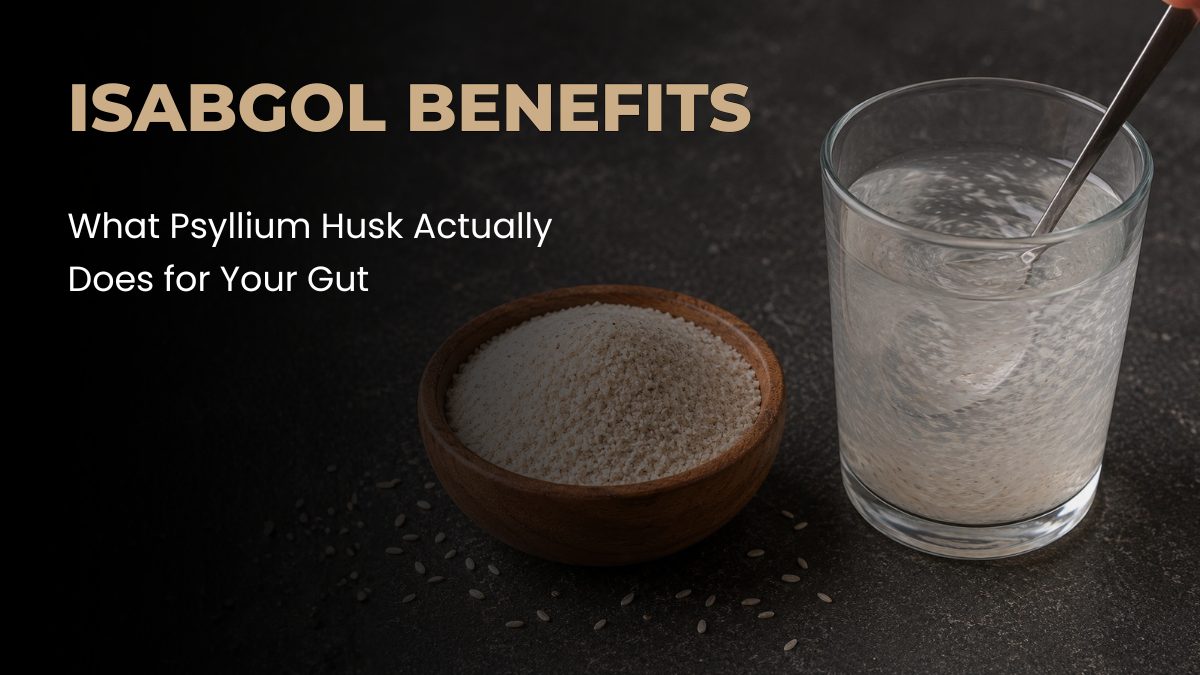
Every Indian household has a box of isabgol somewhere — usually at the back of the medicine cabinet, pulled out when someone is constipated, put back and forgotten. That is a significant waste. Isabgol is approximately 70% soluble fibre, which puts it ahead of oats, flaxseeds, and most commercial fibre supplements sold at five times the price. Its effects go well beyond constipation relief — but only if you take it correctly, with enough water, at the right time. Most people get at least one of those things wrong.
Quick Answer: Isabgol — psyllium husk in English — is the dried outer coat of Plantago ovata seeds, grown primarily in Gujarat and Rajasthan. It is approximately 70% soluble fibre. Research consistently supports its use for constipation relief, diarrhoea management, blood sugar regulation, and LDL cholesterol reduction. It works by forming a gel in the gut that slows digestion, softens stool, and feeds beneficial bacteria. It must always be taken with a full glass of water — never dry.
India Grows 85% of the World's Isabgol — and Most Indians Underuse It
Isabgol is the Hindi name. Psyllium husk is the English name on supplement labels globally. Both refer to the dried outer husk of Plantago ovata seeds. Gujarat alone produces roughly 85% of the world's supply — which makes the premium-priced "psyllium fibre capsules" sold in Western health stores essentially Indian isabgol, repackaged and sold back at ten times the cost. The raw material most likely started in a field in Mehsana or Banaskantha.
You will find it in two forms. Whole husk — the coarser, flakier version — is what older generations mixed into water and drank quickly before it gelled. Powder — more finely ground — dissolves more smoothly and is easier to stir into food or drinks. The nutritional profile is virtually identical between the two. The choice is about texture preference and how you plan to use it.
What makes isabgol stand apart from other fibre sources is its composition. Most dietary fibre is a mix of soluble and insoluble. Isabgol is approximately 70% soluble fibre — the kind that absorbs water, forms a gel, and produces the most significant effects on blood sugar, cholesterol, and gut health. Oats, widely regarded as a benchmark fibre food, are roughly 55% soluble. Isabgol beats them on this specific measure by a substantial margin, at a fraction of the cost.
What Isabgol Actually Does in Your Gut — Not "Aids Digestion," the Actual Mechanism
When isabgol contacts water in your digestive tract, it absorbs it quickly and forms a viscous gel. That gel does several distinct things. Understanding each one separately is more useful than the vague category of "good for digestion."
It relieves constipation by changing the physics of stool. The gel increases both the bulk and moisture content of stool, making it softer and easier to pass. It also physically stimulates the colon walls, triggering peristaltic movement. This is not a laxative mechanism — isabgol does not irritate the gut or cause cramping the way stimulant laxatives do. It works mechanically, which is why it is safe for regular daily use in a way that chemical laxatives are not.
It also stops diarrhoea — the same mechanism, opposite outcome. This surprises most people. The same gel that adds bulk to loose stool firms it up. Isabgol absorbs excess water in the gut, slowing transit and reducing urgency. It is one of the rare ingredients that genuinely works for both constipation and diarrhoea, depending on what your gut needs. This is why it appears in clinical protocols for irritable bowel syndrome, where patients alternate between both conditions.
It flattens blood sugar spikes after meals. The gel slows the rate at which glucose from food enters your bloodstream — not just in theory, but in measured clinical outcomes. A randomised controlled trial published in the Journal of Nutrition and Metabolism (2016) found that psyllium supplementation over 8 weeks significantly reduced fasting blood sugar, HbA1c, and insulin resistance in Type 2 diabetes patients. The reduction in fasting blood glucose was from 163 to 119 mg/dL — a clinically meaningful change, not a marginal one.
It reduces LDL cholesterol — with some of the strongest evidence available for a dietary fibre. The gel binds bile acids in the gut, preventing their reabsorption. The liver then draws on circulating cholesterol to produce more bile acids, which reduces the cholesterol pool in your bloodstream. A 2018 systematic review and meta-analysis in the American Journal of Clinical Nutrition, covering randomised controlled trials, found that approximately 10g of psyllium daily reduced LDL cholesterol by 0.33 mmol/L — a significant effect that held across populations with and without hypercholesterolaemia.
It feeds your gut bacteria. The soluble fibre in isabgol is fermented by beneficial bacteria in the colon, producing short-chain fatty acids that reduce gut inflammation and support microbiome diversity. This prebiotic effect is why consistent isabgol use improves overall gut health over time, not just stool consistency. One or two doses fixes a constipation episode. Daily use over weeks changes the gut environment.
The One Rule Most People Break — and Why It Matters
Take isabgol with a full glass of water. Not half a glass. Not a few sips. A full 200–250ml glass, immediately after mixing, before the husk gels in the glass.
This is not optional and it is not a mild precaution. Isabgol swallowed without sufficient water can swell in the oesophagus or stomach before reaching the intestine, causing a blockage. There are documented cases of oesophageal obstruction from psyllium taken without adequate liquid. The product packaging says "drink plenty of water" because this is a genuine safety requirement, not boilerplate.
The second common mistake: mixing isabgol into a thick liquid and waiting too long before drinking it. Once the husk gels fully in the glass, it becomes difficult to swallow and the texture becomes unpleasant. Mix and drink immediately. If you prefer, chase it with another half glass of water.
The Best Time to Take Isabgol — and Why It Depends on What You Want
The right timing for isabgol is not universal — it depends on what you are using it for.
For constipation relief: Before bed is the most effective timing. The gel forms overnight, softens stool by morning, and produces a bowel movement shortly after waking. One teaspoon in a full glass of warm water or warm milk before sleeping is the traditional Indian approach — and it works for this specific purpose.
For blood sugar management: Before meals — specifically 20–30 minutes before eating. The gel needs to be in place in the gut when food arrives to slow glucose absorption effectively. Taking it after a meal misses the window.
For cholesterol reduction: The research used twice-daily dosing — once before breakfast and once before dinner — typically 5g each time. This is the protocol that produced the LDL reductions in the clinical trials.
For general gut health and daily fibre: Morning on an empty stomach is the most practical choice for most people. One teaspoon stirred into a glass of water, drunk before breakfast, makes isabgol a habit that takes 60 seconds and requires no planning.
Isabgol Powder vs Whole Husk — Which One Should You Buy?
The nutritional difference is negligible. Both forms contain the same soluble fibre content from the same Plantago ovata husk. The practical differences are worth knowing.
Whole husk has a slightly coarser texture and takes marginally longer to dissolve. Some people find it easier to drink quickly before it forms a thick gel. It is also the form most Indian households have used for generations — mixed into water or chaas and drunk fast.
Powder dissolves more smoothly and blends more easily into yogurt, smoothies, or rotis. If you want to add isabgol to food rather than drink it separately, powder is more practical. It also works well stirred into dal or khichdi — the flavour is almost entirely neutral, so it does not change the taste of whatever you add it to.
Both forms work. The one you will actually take consistently is the right choice. For certified organic isabgol with verified sourcing, browse PureStora's Health & Wellness range — every product is verified before listing.
Who Should Not Take Isabgol Without Medical Supervision
Isabgol is safe for most healthy adults at recommended doses. There are specific situations where caution or medical guidance is necessary.
If you are on diabetes medication — particularly insulin — isabgol's blood sugar lowering effect can compound the medication's effect and cause hypoglycaemia. Insulin doses may need adjustment. This is not a theoretical risk — it is in the clinical data. Talk to your doctor before making isabgol a daily habit if you are on diabetes medication.
If you have difficulty swallowing, a history of oesophageal problems, or bowel obstruction — do not use isabgol without medical advice. The swelling mechanism that makes it useful for digestion is the same mechanism that creates risk in a narrowed digestive tract.
If you are pregnant — isabgol in normal culinary amounts is generally considered safe, but high-dose supplementation should be discussed with a doctor. And if you are on any prescription medication, take isabgol at least 2 hours apart — the gel can reduce the absorption rate of medications taken simultaneously.
Frequently Asked Questions
What are the benefits of taking isabgol daily?
Daily isabgol intake — typically 5–10g in water — supports bowel regularity, feeds beneficial gut bacteria through its prebiotic fibre content, and over weeks, produces measurable reductions in LDL cholesterol and post-meal blood glucose. It is one of the few dietary supplements with strong clinical evidence across multiple health outcomes. Most healthy adults can use it daily without issue, provided it is always taken with sufficient water.
Can isabgol help with weight loss?
The mechanism is sound: soluble fibre expands in the stomach, increases satiety, and slows glucose absorption — all of which support reduced calorie intake. The 2016 RCT referenced above found that psyllium supplementation also produced significant reductions in BMI alongside blood sugar improvements. Isabgol is not a weight-loss product, but replacing a low-fibre breakfast with one that includes isabgol is a structural dietary improvement that most people notice in how long they stay full through the morning.
What is the best time to take isabgol?
It depends on what you want. For constipation: before bed in warm water or warm milk. For blood sugar management: 20–30 minutes before meals. For cholesterol: twice daily before meals. For general gut health: morning on an empty stomach. In all cases — always with a full 200–250ml glass of water immediately after mixing.
Is isabgol the same as psyllium husk?
Yes — isabgol and psyllium husk are the same ingredient. Both refer to the dried outer husk of Plantago ovata seeds. Isabgol is the Hindi and Indian commercial name. Psyllium husk is the English name used on supplement labels internationally. India produces roughly 85% of the world's supply, primarily from Gujarat and Rajasthan.
Can I take isabgol if I have diabetes?
Research suggests isabgol may help improve blood sugar regulation — the 2016 clinical trial found meaningful reductions in fasting glucose and HbA1c in Type 2 diabetes patients over 8 weeks. However, if you are on diabetes medication, particularly insulin, isabgol's glucose-lowering effect can compound the medication and cause hypoglycaemia. Always consult your doctor before adding isabgol to your daily routine if you are managing diabetes with medication.
How is isabgol different from sabja seeds?
Both form a gel in water and support digestion, but they are different ingredients with different mechanisms. Isabgol is 70% soluble fibre and works primarily through its gel-forming mucilage — it has the strongest clinical evidence for constipation, diarrhoea, blood sugar, and cholesterol. Sabja seeds (sweet basil seeds) also gel in water but deliver omega-3 fatty acids, calcium, and iron alongside fibre — their traditional use is more as a cooling summer drink ingredient. For more on sabja seeds and how they work, see our post on sabja seeds benefits.
Conclusion
Isabgol's case is unusually well-supported for a kitchen-cabinet ingredient — constipation relief, diarrhoea management, blood sugar regulation, and LDL reduction, all with clinical trial evidence behind them. The only variables are taking it with enough water and being consistent about it. One teaspoon a day in a glass of water is a dietary habit that costs almost nothing and has more evidence behind it than most supplements people spend significantly more on. For certified organic psyllium husk with verified sourcing, browse PureStora's Health & Wellness range. For other Ayurvedic ingredients with similarly strong research backing, see our guide on Ayurvedic superfoods and what the research actually says.
Disclaimer: This article is for general informational purposes only and is not a substitute for medical, nutritional, or professional advice. Consult a qualified healthcare provider before making significant dietary changes, particularly if you are managing a health condition or taking medication.
