
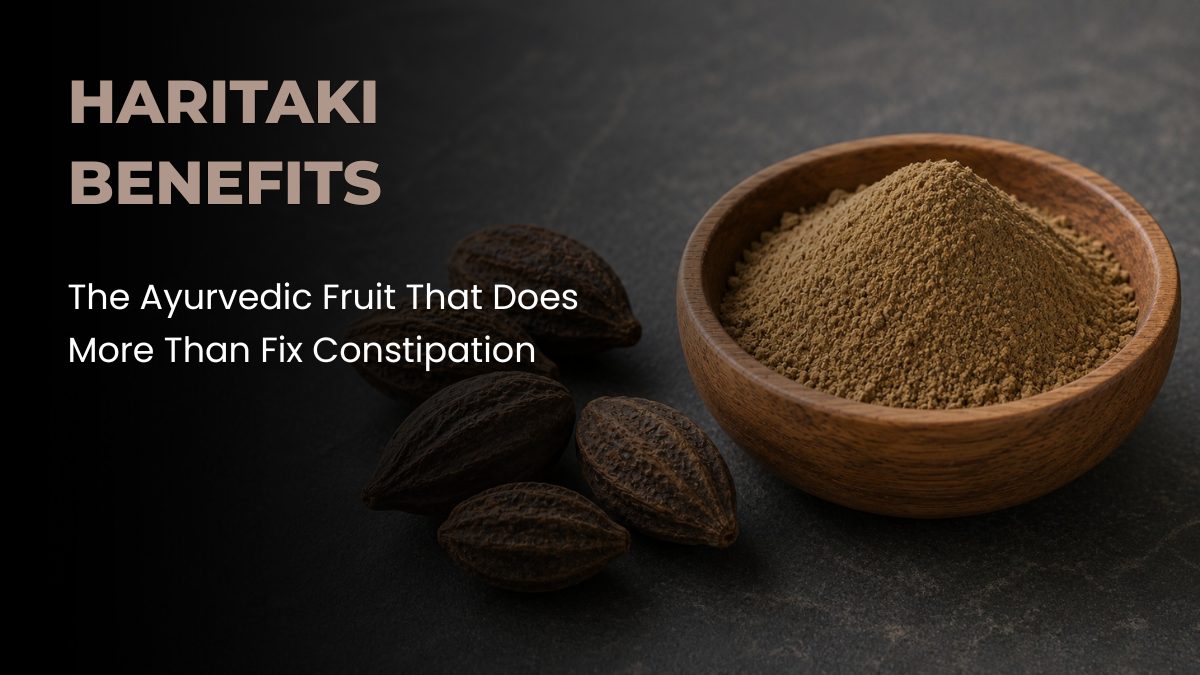
In Tibetan medicine, Terminalia chebula — known as haritaki in Sanskrit, harad in Hindi — is called the "King of Medicines." That is a significant claim for a small dried fruit that most Indians know only as a constipation remedy. The actual pharmacological profile of haritaki is considerably wider than its reputation: its primary active compounds, chebulinic acid and gallic acid, are among the most potent antioxidants studied in Ayurvedic medicine, with documented effects on digestive health, cholesterol, blood sugar regulation, and inflammation. Most people use a fraction of what this ingredient can do — and most people who use it are also using the wrong form.
Quick Answer: Haritaki is the dried fruit of Terminalia chebula, a tree native to South Asia and a foundational herb in Ayurveda. It is best known as one of the three fruits in triphala — the others being amalaki (amla) and bibhitaki. Haritaki's active compounds include chebulinic acid, chebulagic acid, gallic acid, and ellagic acid — tannins and polyphenols with antioxidant, anti-inflammatory, laxative, and antimicrobial properties. The Ayurvedic Pharmacopoeia of India documents haritaki primarily for its Anulomana property — the ability to regulate bowel movement. Research also supports effects on cholesterol, blood sugar, and gut health. It works best as part of triphala rather than as a standalone herb.
What Haritaki Actually Contains — and Why the Tannins Are the Story
The pharmacological identity of haritaki is its tannin content. The fruit contains approximately 30% astringent tannins by dry weight — among the highest concentrations in any commonly used Ayurvedic herb. The primary compounds are chebulinic acid, chebulagic acid, corilagin, gallic acid, and ellagic acid. These are not generic antioxidants — each has documented, specific mechanisms.
Gallic acid is one of the most studied natural antioxidants in pharmacological research. It neutralises free radicals, inhibits lipid peroxidation — the process by which fats in cell membranes are damaged by oxidative stress — and has demonstrated anti-inflammatory effects through inhibition of pro-inflammatory enzyme pathways. Ellagic acid, also found in pomegranates and jamun seeds, adds further antioxidant and anti-inflammatory activity.
Chebulinic acid is the compound that distinguishes haritaki from most other Ayurvedic herbs. It has demonstrated inhibitory effects against multiple bacterial and fungal species in laboratory studies, and research suggests it may inhibit the enzyme alpha-glucosidase — the same enzyme targeted by some oral diabetes medications — which slows the breakdown of carbohydrates into glucose after meals.
The combined tannin profile gives haritaki its characteristic dual action: mildly laxative at lower doses and astringent (constipating) at higher doses. This is not a contradiction — it reflects the dose-dependent behaviour of tannins on intestinal motility, which is why Ayurvedic texts specify different dosages for different digestive conditions.
What Haritaki Does for Digestion — the Mechanism and the Honest Evidence
The most documented use of haritaki in both classical Ayurveda and modern research is its effect on bowel regulation. The Ayurvedic Pharmacopoeia of India, published by the Ministry of AYUSH, classifies haritaki under Anulomana — the category of herbs that normalise bowel movement rather than simply purging. This distinction matters practically: haritaki is not a stimulant laxative. It does not cause cramping or urgency.
A study published in AYU Journal (2013) — the official journal of Gujarat Ayurved University, tested two forms of haritaki on intestinal transit time using standardised methodology. Both churna (powder) and vati (tablet) forms of haritaki significantly shortened intestinal transit time. The churna form was more effective — which is consistent with Ayurvedic texts that have long recommended the powder form for digestive conditions specifically.
The mechanism is the tannins acting on the smooth muscle of the colon — at lower doses, they mildly stimulate peristalsis. At higher doses, the same astringent tannins slow gut motility, which is why haritaki has a traditional use in diarrhoea management as well. The dose determines the direction of effect. This bidirectional action is not unique to haritaki — isabgol works similarly — but haritaki's mechanism is pharmacological rather than physical.
Haritaki and Cholesterol — What the Research Shows
A study published in the Ancient Science of Life journal (2012) found that haritaki produced significant reductions in total cholesterol, triglycerides, and LDL in atherogenic diet-induced hyperlipidaemic rats, while raising HDL. The researchers identified haritaki as an "excellent lipid-lowering agent" at the doses studied.
The mechanism is the same as the one established for soluble fibre and bile acid binding — haritaki's tannins bind bile acids in the gut, reducing their reabsorption and prompting the liver to draw on circulating cholesterol to produce replacement bile acids. This is the same pathway through which isabgol reduces LDL, and through which statins work at a different point in the same process.
The honest limitation: this is animal research, not a human RCT. The cholesterol evidence for haritaki as a standalone herb in humans is limited. The stronger human evidence for this mechanism comes from triphala studies, where haritaki is one of three active ingredients. If cholesterol management is the primary goal, triphala is the better-evidenced choice — haritaki is one component of that formula, not a standalone intervention with the same evidence base.
Why Triphala Is More Effective Than Haritaki Alone
This is the most important practical point in this post. Haritaki is one of three fruits in triphala — alongside amalaki (amla, rich in vitamin C and antioxidants) and bibhitaki (Terminalia bellirica, which adds bronchodilatory and lipid-lowering properties). In Ayurvedic formulation theory, the three herbs are synergistic — each covers what the others lack.
For digestive health specifically, triphala has considerably more human clinical evidence than haritaki alone. Research has shown triphala modulates gut microbiota, increases butyrate-producing bacteria, reduces constipation and bloating, and supports colon health — findings from human trials and in vitro gut microbiome studies. Haritaki contributes the bowel-regulating and antioxidant properties; amalaki contributes vitamin C and immune support; bibhitaki adds lipid management.
If you are choosing between haritaki powder and triphala powder for general gut health, triphala is the more complete and better-evidenced choice. Haritaki as a standalone is most appropriate when the primary goal is specifically its Anulomana (bowel-regulating) property — particularly for chronic constipation — or when its antioxidant and antimicrobial properties are the target. PureStora carries Ecotyl Triphala Powder — made from amalaki, bibhitaki, and haritaki — for those who want the complete formula. For haritaki-specific uses, browse the full Health & Wellness range.
How to Use Haritaki Powder — Dose, Timing, and What Changes the Effect
The traditional Ayurvedic dose for haritaki churna (powder) is 3–5g, taken with warm water. The timing and accompaniment change what it does — which is a practical piece of Ayurvedic knowledge that most modern supplement instructions ignore.
For constipation relief: 3–5g with warm water at bedtime. The mild laxative effect works overnight and produces a bowel movement in the morning. This is the most common use and the one with the most clinical support.
For digestive support after meals: A smaller dose — 1–2g — taken after food with warm water. At this dose haritaki supports digestion without the laxative effect. Traditional texts mention combining it with rock salt (kala namak) for post-meal use.
For diarrhoea management: Higher doses — 5g or more — with buttermilk (chaas). At higher doses the astringent tannins slow gut motility. This is the traditional approach and it reverses the lower-dose laxative direction.
Warm water is the standard carrier — it dissolves the powder more fully than cold water. Some traditional preparations combine haritaki with ghee for Rasayana (rejuvenative) use, or with honey for respiratory conditions. These are compound applications beyond the scope of dietary supplementation.
What to Check When Buying Haritaki Powder
Haritaki powder quality varies primarily by fruit maturity and processing. Ripe, fully mature haritaki fruits have the highest tannin content and the strongest medicinal properties. Unripe fruits are sometimes processed together with ripe ones to increase volume — the result is a product with lower active compound concentration.
Colour: Good haritaki churna is a warm yellow-brown to tan colour. Very pale powder suggests unripe fruit or over-drying. Very dark powder may indicate over-processing or mixing with other fruit material.
Taste: Genuine haritaki churna is strongly astringent — it should make your mouth feel dry when tasted. A weak or bland taste indicates low tannin content and likely reduced efficacy. The astringency is the quality marker, not a defect.
Single ingredient: The label should show Terminalia chebula as the sole ingredient. Some products combine haritaki with black pepper or long pepper (pippali) — traditional formulations that are not inherently inferior but are compound products, not pure haritaki.
For certified organic haritaki with verified sourcing, browse PureStora's Health & Wellness range — every vendor is verified before listing.
Frequently Asked Questions
What is haritaki used for in Ayurveda?
Haritaki is classified in Ayurveda as a Rasayana — a rejuvenative herb — and specifically as an Anulomana drug, meaning it normalises bowel movement. The Ayurvedic Pharmacopoeia of India documents it for constipation relief, digestive regulation, and as a tonic herb for long-term use. It is also a key component of triphala, one of Ayurveda's most widely used formulations. Modern research supports antioxidant, anti-inflammatory, cholesterol-lowering, and antimicrobial properties through its tannin compounds.
Is haritaki the same as harad?
Yes — haritaki and harad refer to the same plant: Terminalia chebula. Haritaki is the Sanskrit name used in Ayurvedic texts and on most supplement labels. Harad is the common Hindi name used in households and traditional medicine across North India. In Telugu it is called Karkchettu; in Tamil, Kadukkaya. All refer to the dried fruit of Terminalia chebula.
Should I take haritaki or triphala?
For most general purposes — gut health, digestive regularity, antioxidant support — triphala is the better choice because it combines haritaki with amalaki and bibhitaki, producing a more complete formula with stronger human clinical evidence. Haritaki alone is most appropriate when the specific goal is bowel regulation (Anulomana property) or when its antimicrobial and blood sugar properties are the target. If you are unsure, start with triphala — haritaki is one of its three ingredients. For more on sabja seeds and digestion, see our post on isabgol benefits and how gut-regulating herbs work.
What is the right dose of haritaki powder?
For constipation: 3–5g with warm water at bedtime. For post-meal digestive support: 1–2g with warm water after food. For diarrhoea management: 5g or more with buttermilk. The dose determines the direction of effect — lower doses are mildly laxative, higher doses are astringent and slow gut motility. Start at the lower end and adjust based on your response. Pregnant women and people on medication should consult a doctor before use.
Can haritaki be taken daily?
Yes — haritaki is classified as a Rasayana in Ayurveda, meaning it is intended for long-term daily use rather than short-term treatment. At standard doses (3–5g daily) it is generally considered safe for healthy adults. The most common side effect at higher doses is loose stools — which is the intended effect at that dose. If you experience persistent digestive discomfort, reduce the dose or switch to the post-meal format (1–2g). People with chronic health conditions or on regular medication should consult a doctor before long-term use.
How is haritaki different from triphala?
Haritaki is one of the three fruits in triphala — the others are amalaki (amla) and bibhitaki. Triphala combines all three in equal proportions. Haritaki contributes the bowel-regulating and antioxidant properties. Amalaki adds vitamin C, immune support, and anti-inflammatory effects. Bibhitaki adds respiratory and lipid-management benefits. Triphala has broader human clinical evidence than haritaki as a standalone herb. See our guide on Ayurvedic superfoods for more on how these herbs compare.
Conclusion
Haritaki is a genuinely useful Ayurvedic herb with a well-understood mechanism — its tannins regulate bowel motility, reduce oxidative stress, and support cholesterol management through bile acid binding. The honest qualifier is that most of the strongest human evidence comes from triphala studies, where haritaki is one of three active ingredients. As a standalone herb, it is most valuable for its bowel-regulating property, where the AYU Journal study confirms the churna form works specifically and measurably. For most people, triphala is the more practical daily choice — and PureStora carries Ecotyl Triphala Powder for exactly that purpose.
Disclaimer: This article is for general informational purposes only and is not a substitute for medical, nutritional, or professional advice. Haritaki is not a treatment or cure for any health condition. Consult a qualified healthcare provider before use if you are pregnant, on medication, or managing a health condition.
