
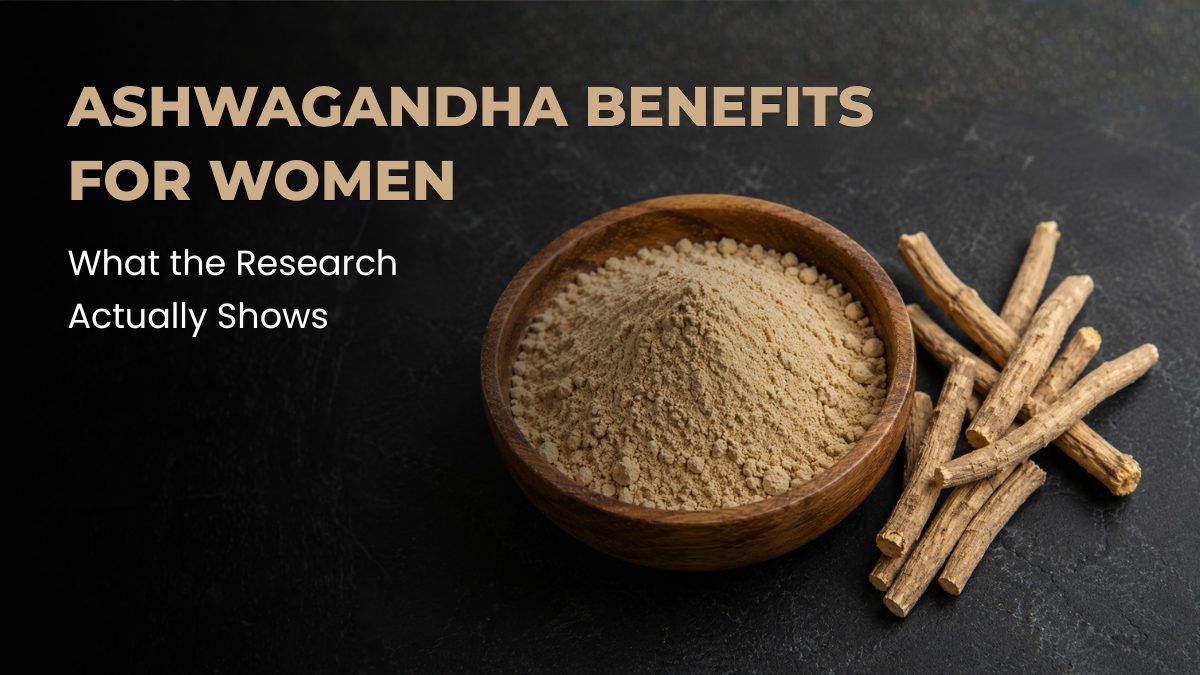
Search "ashwagandha benefits" and almost everything you find is written for men — testosterone, gym recovery, stress at work. Which is strange, because the reason ashwagandha actually works has nothing to do with testosterone. It works by reducing cortisol — your primary stress hormone — and that is at least as relevant to women as it is to men. Possibly more so. Because when cortisol stays chronically high in a woman's body, it quietly disrupts estrogen, progesterone, thyroid function, sleep, and menstrual regularity in ways that show up as a dozen different problems that seem unrelated. The research on ashwagandha for women specifically is now substantial. Here is what it actually shows — in plain language.
Quick Answer: Ashwagandha is an Ayurvedic root that reduces cortisol — your stress hormone — and through that, supports hormonal balance, better sleep, improved energy, and reduced PMS and menopausal symptoms. For women specifically, clinical trials show improvements in hormonal markers, menopausal symptoms, sexual health, and stress. Crucially — unlike in men, ashwagandha does not raise testosterone in women, making it safe for female hormonal contexts including PCOS. Standard dose is 300–600mg of root extract daily for a minimum of 8 weeks.
The Cortisol Problem — and Why It Hits Women Harder Than Most People Realise
Here is something most doctors do not explain clearly. Cortisol — the hormone your body releases when you are stressed — and the female reproductive hormones — estrogen and progesterone — are made from the same raw material in your body. When you are chronically stressed, your body prioritises making cortisol over making reproductive hormones. It is a survival trade-off: stress response now, reproduction later.
The practical result, for a woman living with chronic stress — which in India typically means managing career, household, children, and family simultaneously — is a cascade of symptoms that seem unconnected: irregular periods, worsening PMS, difficulty sleeping, persistent fatigue that does not improve with rest, low libido, mood instability, and perimenopausal symptoms arriving earlier than expected. These are not separate problems. They are all downstream effects of the same cortisol issue.
Ashwagandha's primary job is reducing cortisol. That is it. And because of how cortisol connects to everything else in a woman's hormonal system, fixing that one thing ripples into improvements across all those symptoms. This is why women taking ashwagandha report improvements in sleep, mood, periods, and energy simultaneously — not because ashwagandha is a miracle herb, but because they were all caused by the same root problem.
What Happened When Researchers Gave It to Perimenopausal Women
A randomised, double-blind, placebo-controlled trial — the gold standard in clinical research — gave ashwagandha root extract to 60 women aged 45–55 for 56 days. The other half got a placebo. Neither group knew which they were taking.
The results, published in a 2024 peer-reviewed trial, were clear across every measure. Hot flashes reduced significantly. Estradiol and progesterone levels improved. Stress scores dropped. Quality of life scores improved. The researchers measured hormonal markers directly — not just how women felt — and found real changes in blood hormone levels after 8 weeks.
For women in perimenopause who want an alternative to hormone replacement therapy — or who cannot use HRT for medical reasons — this is one of the more credible options the research currently supports. It is not a replacement for medical care. But it is a well-evidenced herbal addition that addresses the actual hormonal mechanism, not just symptoms.
What About PCOS — the Question Most Indian Women Are Actually Asking
PCOS affects roughly 1 in 5 Indian women of reproductive age. The combination of elevated androgens, insulin resistance, irregular periods, and chronic low-grade inflammation makes it one of the most complex hormonal conditions to manage.
A 2025 review in Cureus journal specifically evaluated ashwagandha's potential in PCOS and PMS. The finding that matters most for women with PCOS: ashwagandha does not raise testosterone in women. In men, it does — which is why all the gym marketing exists. In women, the effect on androgens is different. It does not add to the androgen excess that makes PCOS worse.
What it may do: reduce the cortisol-driven hormonal dysregulation that makes PCOS symptoms worse, improve insulin sensitivity markers, and support more regular ovulation. Most of this evidence comes from lab models rather than large human trials on PCOS-diagnosed women specifically. The direction is promising. The honest caveat is that if you have diagnosed PCOS, treat ashwagandha as a potential supportive addition — not a treatment — and discuss it with your gynaecologist before starting.
The Benefit Nobody Talks About — Sexual Health
An 8-week clinical trial conducted at DY Patil Medical College, Navi Mumbai — an Indian study, on Indian women — tested ashwagandha specifically for sexual health in healthy women. The study, published in Cureus, measured arousal, lubrication, satisfaction, orgasm, and sexual distress using validated clinical scales.
The ashwagandha group scored significantly higher across every measure compared to placebo. The researchers identified two reasons. First, reduced cortisol and anxiety — the psychological state that determines sexual response in women more than any physical factor. Second, improved blood flow and physiological response that follows from lower chronic stress. Low libido in women is very often a stress problem wearing a different face. Ashwagandha addresses it at that level.
Thyroid — What You Should Know Before Starting
Hypothyroidism — underactive thyroid — affects women roughly 5–10 times more than men in India. Research suggests ashwagandha may support thyroid function when levels are low or borderline — studies have found improvements in T3 and T4 levels in subclinical hypothyroidism. The mechanism is the same cortisol pathway: high cortisol suppresses thyroid hormone production, and reducing cortisol allows the thyroid to function more normally.
But this cuts both ways. If your thyroid is overactive — hyperthyroidism — further stimulation is the last thing you need. Women with any diagnosed thyroid condition should check with their endocrinologist before adding ashwagandha. This is not a precaution for healthy women — it is specifically for those already managing thyroid disease.
How to Actually Take It — Dose, Timing, and What to Expect
The dose that produces results in clinical trials is 300–600mg of standardised ashwagandha root extract per day. "Standardised" means the product specifies its withanolide content on the label — withanolides are the active compounds. Look for at least 5% withanolides. If a product just says "ashwagandha powder" with no withanolide percentage, you do not know how potent it is.
Timing: evening with warm milk is the traditional Ayurvedic approach and it makes practical sense — the cortisol-lowering effect supports sleep, which is often the first improvement women notice. Morning works too for energy and hormonal support. Do not take it on an empty stomach when starting — mild nausea is the most common early side effect and it usually disappears within a week.
Most importantly: give it 8 weeks minimum before deciding whether it is working. Stress reduction and sleep improvements show up within 4–6 weeks. Hormonal benefits — more regular periods, reduced PMS, improved menopausal symptoms — take 8–12 weeks. Taking it for 2 weeks and concluding "it does nothing" is how most people miss the actual results.
For certified organic ashwagandha root powder, PureStora carries Ecotyl Ashwagandha Root Powder 100g and Ashwagandha Powder 100g by Bionode Organics — both verified before listing. Browse the full Health & Wellness range for other certified Ayurvedic powders.
Who Should Not Take Ashwagandha
Pregnant women — do not take it. Ashwagandha has traditionally been used to stimulate uterine contractions. This is not a mild caution — avoid it entirely during pregnancy.
Women with thyroid conditions — check with your endocrinologist first. Both hypothyroid and hyperthyroid contexts can be affected, in opposite directions.
Women with autoimmune conditions — lupus, rheumatoid arthritis, Hashimoto's — ashwagandha stimulates immune activity, which can worsen autoimmune responses. Medical guidance needed before use.
Women with hormone-sensitive cancers, uterine fibroids, or endometriosis — the hormonal modulation effects require a conversation with your oncologist or gynaecologist first.
Women on sedatives — ashwagandha's sleep-promoting effect can compound sedative medications. Shift to morning use or reduce dose if you notice excessive drowsiness.
Frequently Asked Questions
Does ashwagandha raise testosterone in women?
No — this is one of the most important and least-known findings in the research. Ashwagandha raises testosterone in men — which is why it dominates fitness marketing. In women, the effect on androgens is sex-specific and does not produce the same testosterone elevation. A 2025 review specifically confirmed this distinction. This matters particularly for women with PCOS, where high androgens are already a problem. Ashwagandha does not make that worse.
Can ashwagandha help with PCOS?
Research suggests it may help with the cortisol and stress-driven aspects of PCOS — reducing cortisol, supporting more regular hormonal cycles, and potentially improving insulin sensitivity. It does not treat PCOS directly. Think of it as a supportive addition to a PCOS management plan, not a standalone solution. Discuss with your gynaecologist before starting, particularly if you are on medication for PCOS.
How long does ashwagandha take to work for women?
Sleep and stress improvements are usually noticeable within 4–6 weeks. Hormonal benefits — menstrual regularity, PMS improvement, reduced menopausal symptoms — take 8–12 weeks. The clinical trials that produced clear results used 56–90 day protocols. If you try it for 2 weeks and notice nothing, that is not evidence it does not work — it is evidence you have not given it enough time yet.
Is ashwagandha safe to take every day for women?
For healthy women without thyroid conditions, autoimmune diseases, or hormone-sensitive conditions, daily use at 300–600mg is generally considered safe based on current research. Take breaks — 8–12 weeks on, 4 weeks off is a sensible cycling approach rather than indefinite continuous supplementation. Pregnant women should not take it. For more on Ayurvedic adaptogens that work alongside ashwagandha, see our post on Ayurvedic superfoods and what the research says.
How does ashwagandha compare to brahmi for women?
They do different things. Ashwagandha reduces cortisol and supports hormonal balance — it is the right choice for stress-driven hormonal disruption, sleep problems, low energy, and perimenopausal symptoms. Brahmi repairs neurons and improves memory and focus — it is the right choice for brain fog, poor concentration, and anxiety that shows up as cognitive difficulty. Many women find both useful together. For more on brahmi specifically, see our post on brahmi powder benefits.
Can ashwagandha help with perimenopause?
Yes — this is actually the area with the strongest clinical evidence. A randomised controlled trial in 60 perimenopausal women found significant reductions in hot flashes, improved estrogen and progesterone levels, lower stress, and better quality of life after 8 weeks compared to placebo. For women looking for a non-hormonal option for perimenopausal symptoms, ashwagandha is one of the more credible herbal choices the research currently supports.
Conclusion
Ashwagandha's benefits for women come down to one thing done well: it reduces cortisol. And because cortisol connects to hormonal balance, sleep, energy, sexual health, and thyroid function in women through a series of well-understood mechanisms, fixing that one thing creates a ripple of improvements that look like separate benefits but are not. The research supports this across multiple Indian and international clinical trials. The key is consistency — 8–12 weeks at the right dose — and knowing the contraindications. For certified organic ashwagandha with transparent sourcing, browse PureStora's Health & Wellness range.
Disclaimer: This article is for general informational purposes only and is not a substitute for medical or gynaecological advice. Ashwagandha is contraindicated during pregnancy and may interact with thyroid, autoimmune, and hormonal medications. Consult a qualified healthcare provider before supplementing.
