
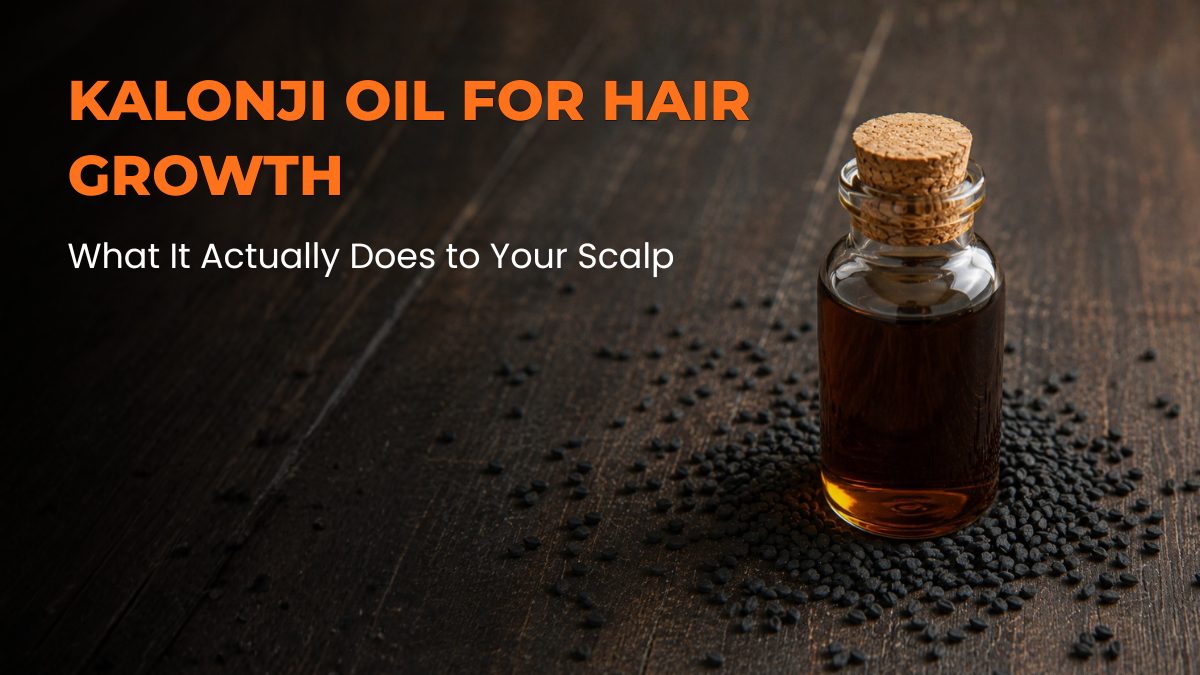
Hair fall is one of the most searched health topics in India. And kalonji oil — cold-pressed oil from the same tiny black seeds you scatter on naan — is one of the most recommended remedies in Indian home hair care, across generations and across regions. But most people using it do not know why it works, which means they also do not know how to use it correctly, how long to expect before seeing results, or whether their specific type of hair loss is the kind kalonji actually helps. All three of those things matter. Here is the honest picture.
Quick Answer: Kalonji oil (cold-pressed Nigella sativa seed oil) works for hair primarily through two mechanisms: reducing scalp inflammation that damages hair follicles, and fighting the fungus that causes dandruff and scalp irritation. Both are real, documented causes of hair thinning and loss in India. Research includes a small study where kalonji lotion significantly increased hair density in people with stress-related hair loss, and a 90-person comparison study where kalonji oil outperformed other seed oils for hair loss reduction. It is not a cure for genetic hair loss (male or female pattern baldness). It is a legitimate scalp health tool for inflammation-driven and fungal-driven hair loss — which covers a large proportion of the hair fall Indians experience.
The Two Hair Problems Kalonji Oil Actually Solves
Before talking about how kalonji works, it helps to understand which type of hair loss you are dealing with. Not all hair loss is the same, and kalonji does not work equally for all of them.
Type 1 — Scalp inflammation causing follicle damage. Your hair follicles — the tiny structures in your scalp that each produce one hair — can become inflamed. When that happens, the follicle shrinks, the hair it produces gets thinner, and eventually the follicle can stop producing hair at all. Scalp inflammation is extremely common in India due to heat, pollution, sweat, tight hairstyles, and chemical-laden shampoos. You may not feel pain or see redness — chronic low-grade follicular inflammation is often invisible until the hair thinning is noticeable.
Kalonji oil's main active compound — thymoquinone — is a powerful anti-inflammatory that penetrates the scalp and reduces the inflammatory signals that damage follicles. Think of it as calming down an irritated scalp at the root level, not just treating symptoms on the surface. A dermaceutical review published in PubMed confirmed kalonji's dermatological applications including scalp and follicle health, citing its anti-inflammatory, antioxidant, and antimicrobial properties as the primary mechanisms.
Type 2 — Dandruff-driven hair loss. Dandruff is caused by a yeast called Malassezia that lives on everyone's scalp but overproliferates in certain conditions — oil, heat, humidity. When Malassezia grows out of control, it irritates the scalp, causes the itching and flaking most people recognise as dandruff, and — less recognised — causes inflammation around the follicles that triggers hair shedding. Many Indians who think they have "hair fall" actually have dandruff-driven hair loss, and treating only the hair fall without addressing the dandruff does not fix the underlying problem.
Kalonji oil has documented antifungal properties against Malassezia specifically. Applied to the scalp as a pre-wash treatment, it reduces the fungal load that drives dandruff-related follicle inflammation. This is why people who use kalonji oil for hair often notice their dandruff improving alongside hair loss reduction — they are treating the same root cause.
What the Research Actually Found
The honest situation with kalonji oil and hair research: the evidence is promising but not yet at the level of large-scale controlled trials. This needs to be said clearly before going into what studies have shown, because kalonji is sometimes marketed with claims that go beyond what the evidence supports.
What does exist: a 2020 review of kalonji and hair loss highlighted a small study in which daily use of a Nigella sativa extract lotion for 3 months significantly increased hair density and thickness in people with telogen effluvium — the medical term for stress-related or shock-related hair shedding, where large numbers of hairs enter the resting phase and fall out simultaneously. This is one of the most common types of hair loss in Indian women, often triggered by childbirth, illness, major stress, rapid weight loss, or nutritional deficiency.
The same review cited a 90-participant comparison study where people used different seed oils for hair loss. Kalonji oil was the most effective at reducing hair loss among the oils tested.
These are small studies. They point in the right direction. They are not the basis for claiming kalonji oil definitively treats hair loss — but they are real data, not just tradition. The mechanism — anti-inflammatory and antifungal action on the scalp — is well-established even where the hair-specific human trials are limited.
What Kalonji Oil Will Not Fix
This matters as much as what it does help with. If you have androgenetic alopecia — the genetic pattern baldness that runs in families, where hair recedes at the temples and crown in men, or thins in a diffuse pattern in women — kalonji oil is not a solution. Androgenetic alopecia is driven by DHT, a hormone derived from testosterone that shrinks hair follicles over time in people genetically predisposed to it. Kalonji oil does not block DHT. It does not reverse follicle miniaturisation. It may slow the inflammatory component of androgenetic alopecia, but it cannot address the genetic hormonal cause.
Similarly, if hair loss is caused by a nutritional deficiency — iron, vitamin D, zinc, or protein — no topical oil will fix it. The follicle needs those nutrients delivered through the bloodstream, not the scalp surface. If you have significant hair shedding, getting your ferritin, vitamin D, and thyroid levels checked is more important than any oil treatment. Topical kalonji can help the scalp environment; it cannot replace nutrition the follicle is not receiving internally.
How to Use Kalonji Oil for Hair — the Right Way
Most people who use kalonji oil and notice no results are making one of three mistakes: using it undiluted, not leaving it long enough, or not being consistent for long enough.
Always dilute it. Kalonji oil is potent. Undiluted on the scalp, it can cause irritation, redness, and even contact dermatitis on sensitive skin. Always mix it with a carrier oil — coconut oil, sesame oil, or almond oil — at a ratio of roughly 1 part kalonji to 4–5 parts carrier. So if you are making 50ml of hair oil, use 8–10ml of kalonji and 40–42ml of carrier. This gives you the active benefit without the irritation risk.
Apply to the scalp, not just the hair. Kalonji oil works on the follicles and scalp, not the hair shaft. Coating the length of your hair in oil and calling it a kalonji treatment misses the point entirely. Part your hair, apply the diluted oil directly to the scalp in sections, and massage for 5–7 minutes. The massage itself improves blood circulation to the follicles — a benefit independent of the oil.
Leave it for at least 30–60 minutes. The anti-inflammatory compounds in kalonji oil need time to penetrate the scalp. A 10-minute application and immediate wash is not enough. Leave it for a minimum of 30 minutes — overnight is ideal if you can manage the oiliness. Wash out thoroughly with a mild shampoo.
Use it 2–3 times per week. Daily use is not necessary and may cause product build-up on the scalp. Twice to three times weekly, consistently over 8–12 weeks, is the protocol that produces results in the studies that showed positive outcomes.
Be patient — minimum 8–12 weeks. Hair grows approximately 1–1.5cm per month. The follicle environment needs time to improve, and new growth needs time to become visible. People who try kalonji oil for 2–3 weeks and see nothing have not given it a fair trial. The small study that showed significant results used 3 months of consistent daily application. You will not see results faster by using more oil or applying it more frequently.
Kalonji Oil vs Other Popular Hair Oils — Where It Fits
Indian hair oiling tradition involves many oils — coconut, castor, bhringraj, amla, neem. Each has a different primary benefit and they are not all interchangeable. Understanding where kalonji fits helps you use it more strategically.
Coconut oil penetrates the hair shaft and reduces protein loss — it is the best oil for hair strength and reducing breakage. It does not have the specific anti-inflammatory or antifungal effects that kalonji has on the scalp. Use coconut as your carrier; add kalonji for scalp treatment.
Castor oil is thick and high in ricinoleic acid, which has mild anti-inflammatory effects and is often used for eyebrow and eyelash growth. For scalp coverage it is too heavy to use alone. Kalonji has stronger documented anti-inflammatory action than castor for scalp conditions specifically.
Bhringraj oil — made from the bhringraj plant (Eclipta alba) — is the most traditional Indian ayurvedic hair oil with the longest documented use in hair loss. Some studies suggest bhringraj stimulates follicles more directly than kalonji. For serious hair thinning, combining bhringraj and kalonji in a carrier base is a reasonable traditional and evidence-directed approach.
Neem oil is the strongest antifungal of the group — more potent against Malassezia than kalonji for dandruff specifically. If dandruff is your primary concern, neem may be more targeted. If scalp inflammation alongside dandruff is the issue, kalonji's combined anti-inflammatory and antifungal profile makes it more suitable.
For cold-pressed kalonji oil and other organic hair care oils, browse PureStora's Food & Beverages range — every vendor is verified before listing.
Frequently Asked Questions
Does kalonji oil actually work for hair growth?
Research supports kalonji oil specifically for hair loss caused by scalp inflammation and fungal dandruff — which covers a large proportion of hair fall in India. A 3-month study found significant improvement in hair density in people with stress-related hair loss. A 90-person comparison found kalonji oil more effective than other seed oils for hair loss reduction. It does not work for genetic pattern baldness (androgenetic alopecia), and it does not replace treatment for nutritional deficiencies that cause hair loss. Used correctly — diluted, applied to the scalp, consistently over 8–12 weeks — it is a legitimate evidence-supported scalp treatment, not just folklore.
How long does kalonji oil take to show results for hair?
Minimum 8–12 weeks of consistent use — 2–3 times per week — before you can fairly assess results. Hair grows 1–1.5cm per month. Scalp inflammation takes weeks to reduce. New follicle activity takes weeks more to produce visible hair. The study that showed significant hair density improvement used 3 months of daily application. Trying kalonji for 2–3 weeks and concluding it does not work is not a fair assessment.
Can I use kalonji oil directly on the scalp?
Not undiluted — kalonji oil is potent and can cause scalp irritation or contact dermatitis on sensitive skin when used neat. Always dilute at a ratio of 1 part kalonji to 4–5 parts carrier oil (coconut, sesame, or almond). Apply the diluted blend to the scalp, massage in, and leave for 30–60 minutes before washing out. If you experience burning or redness, reduce the kalonji proportion further or discontinue use.
Is kalonji oil good for dandruff?
Yes — this is one of its strongest applications for scalp health. Dandruff is caused by Malassezia yeast overgrowing on the scalp. Kalonji oil has documented antifungal properties against this yeast. Applied as a pre-wash scalp treatment 2–3 times weekly, it reduces the fungal load driving dandruff while simultaneously addressing the scalp inflammation that dandruff causes. For more on kalonji's other benefits and the science behind thymoquinone, see our post on kalonji benefits.
What is the best way to use kalonji oil for hair fall?
Mix 8–10ml of cold-pressed kalonji oil with 40ml of coconut or sesame carrier oil. Part your hair and apply directly to the scalp in sections. Massage for 5–7 minutes. Leave for at least 30–60 minutes, or overnight. Wash out with a mild shampoo. Repeat 2–3 times per week. Continue for a minimum of 8–12 weeks before assessing results. Do not apply undiluted. Apply to the scalp — not just the hair length. Consistency over weeks matters more than frequency in a single session.
Can kalonji oil fix genetic hair loss?
No. Androgenetic alopecia — the genetic pattern baldness that runs in families — is driven by a hormone called DHT that shrinks hair follicles over time in genetically predisposed people. Kalonji oil does not block DHT. It cannot reverse follicle miniaturisation that has already occurred. It may help slow the inflammatory component of androgenetic alopecia and improve scalp health generally — but it is not a treatment for genetic hair loss. For androgenetic alopecia, minoxidil and finasteride are the clinically proven treatments. Kalonji can be used as a supportive addition to the scalp care routine alongside those, not instead of them.
Conclusion
Kalonji oil earns its place in Indian hair care because it addresses two real, common causes of hair loss — scalp inflammation and dandruff-causing fungal overgrowth — through mechanisms that are well understood. The human trial evidence is small but points in the right direction. The right expectation is not dramatic regrowth in weeks. It is a gradual improvement in scalp health, reduced shedding, and healthier new growth over 8–12 weeks of consistent use. Diluted correctly, applied to the scalp, used regularly — it is a legitimate tool for the kind of hair loss most Indians actually experience. For the full picture on kalonji's other benefits — blood sugar, inflammation, and more — see our post on kalonji benefits. For cold-pressed kalonji oil with verified sourcing, browse PureStora's Food & Beverages range.
Disclaimer: This article is for general informational purposes only and is not a substitute for medical or dermatological advice. Significant hair loss should be evaluated by a doctor to identify the underlying cause before beginning any topical treatment.
