
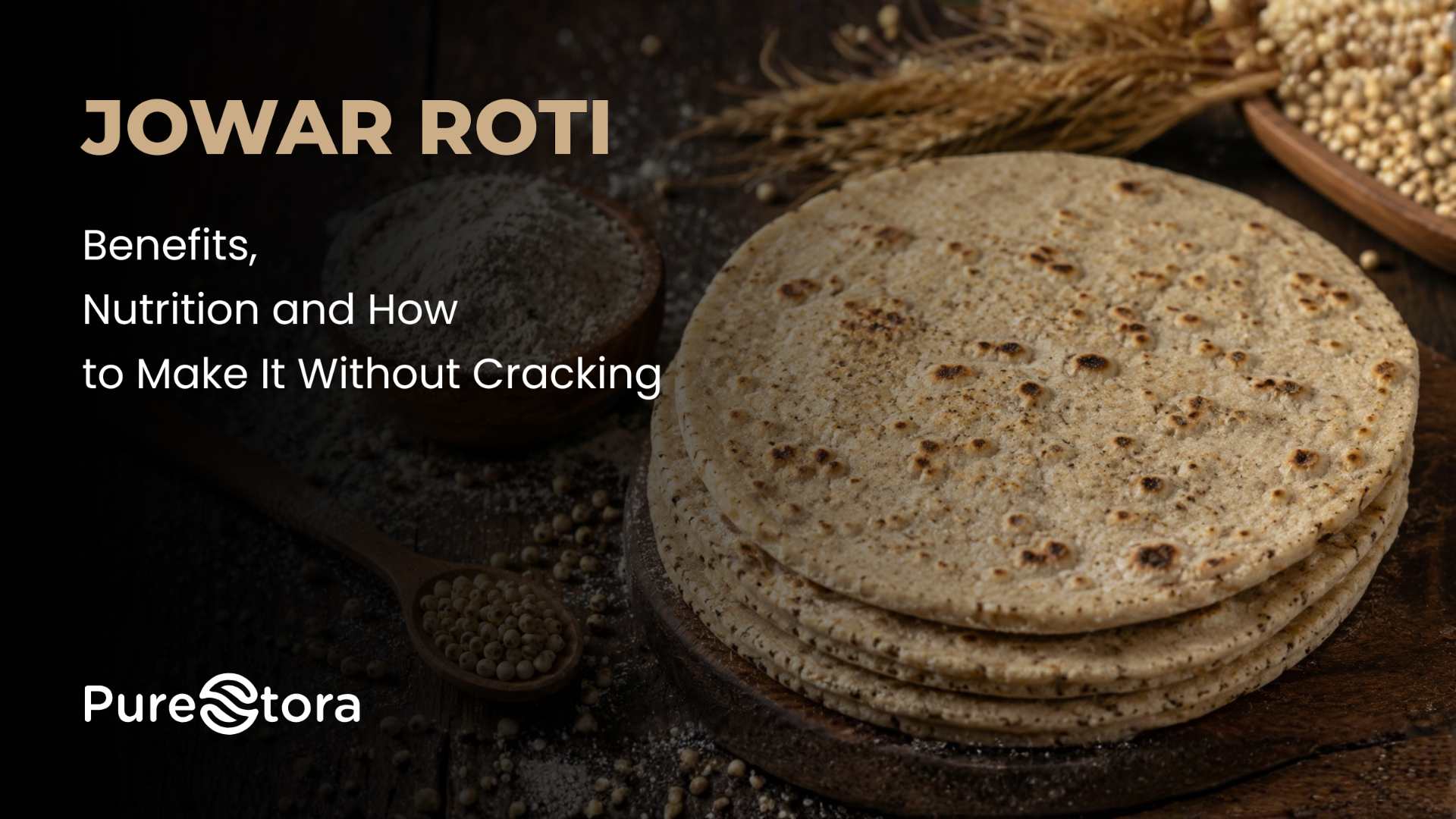
Your grandmother probably made jowar roti without thinking twice about it. It was just what people in Maharashtra, Karnataka, Andhra Pradesh, and Telangana ate — sometimes three times a day. Then wheat flour became cheap, widely available, and easy to roll. Jowar quietly disappeared from most urban kitchens.
It is coming back now — and the nutritional case for it is stronger than most people realise. Jowar roti is not just a gluten-free alternative. It is genuinely better than wheat roti for blood sugar management, digestion, and long-term heart health. Here is what the data actually says — and how to make it without the roti cracking every time you try to roll it.
What Is Jowar?
Jowar is sorghum — Sorghum bicolor — one of the most widely grown crops in India and the world. It is called jowar in Hindi, jonna in Telugu, cholam in Tamil, and jwari in Marathi. The thick roti made from jowar flour is called bhakri in Maharashtra and jolada rotti in Karnataka.
Jowar has been cultivated in India for over 3,000 years. It grows in rain-fed, dryland conditions where wheat and rice struggle — making it a resilient crop for large parts of peninsular India. Research from the ICAR-Indian Institute of Millets Research, Hyderabad and Jayashankar Telangana State Agricultural University (PMC, 2023) highlights jowar's exceptional nutritional profile — particularly its antioxidant compounds, low glycemic index, and potential for biofortification to address micronutrient deficiencies in Indian diets.
Jowar Roti Nutrition — What Is Actually in It
Per 100g of jowar flour (raw), the approximate nutritional values are:
- Energy: 349 kcal
- Carbohydrates: 72g (complex, slow-releasing)
- Protein: 10.4g — higher than wheat flour
- Dietary fibre: 6.3g — significantly higher than refined wheat
- Iron: 4.1mg
- Calcium: 25mg
- Magnesium: 165mg
- Phosphorus: 287mg
- Glycemic Index: approximately 49–62 depending on preparation (low to medium)
One medium jowar roti (approximately 40–45g cooked weight) contains roughly 100–110 calories, 2.5g protein, and 2g dietary fibre. Compare this to a wheat chapati of similar size: similar calories, slightly less fibre, higher glycemic impact, and gluten-containing.
The most important number here is the glycemic index. A study on glycemic responses of multigrain Indian rotis including jowar bhakri (PMC, 2020) found that jowar bhakri consistently produced significantly lower postprandial blood glucose responses compared to wheat roti. The mechanism is the combination of resistant starch, tannins in the bran layer, and high fibre — all three slow down glucose absorption in the gut.
Advantages of Jowar Roti — Benefit by Benefit
Blood sugar management
This is jowar roti's strongest and most directly applicable benefit for Indian households. India has over 100 million people with diabetes — and tens of millions more with prediabetes. The standard Indian diet, heavily built around wheat chapati and white rice, contributes significantly to this problem through its high glycemic load.
Jowar roti addresses this directly. Its low-to-medium glycemic index means glucose enters the bloodstream gradually after a meal — no sharp spike, no corresponding insulin surge, no energy crash an hour later. The tannins in jowar's bran specifically inhibit enzymes that break down starch, slowing carbohydrate digestion in a way that is particularly useful for people managing type 2 diabetes. Research suggests jowar can be used as part of a diabetic meal plan as a substitute for wheat chapati without reducing meal satisfaction.
Digestive health
The fibre content of jowar — 6.3g per 100g raw — is more than double that of refined wheat flour (2.7g). This fibre feeds beneficial gut bacteria, supports bowel regularity, and reduces the bloating that many Indians experience with wheat-heavy diets. The polyphenols and antioxidants in jowar also have documented anti-inflammatory effects on the gut lining.
People who experience bloating, acidity, or heaviness after wheat rotis often find jowar significantly easier to digest. This is partly the fibre, partly the absence of gluten, and partly jowar's naturally lower starch digestibility.
Weight management
Jowar roti keeps you fuller for longer. The mechanism is simple: high fibre slows digestion, which delays hunger. The stable blood sugar from jowar's low GI also prevents the mid-morning or post-meal cravings that refined carbohydrates trigger. You are not fighting hunger — you are simply satisfying it more efficiently.
One jowar roti with dal and sabzi is a genuinely complete, satisfying meal that most people find more filling than the equivalent wheat-based meal. For people managing weight, replacing two wheat rotis per meal with two jowar rotis is one of the most practical dietary changes available — no exotic ingredients, no expensive supplements, no disruption to Indian food culture.
Heart health
Jowar contains phytosterols — plant compounds that compete with dietary cholesterol for absorption in the gut, effectively reducing the amount of cholesterol that enters the bloodstream. It also contains significant amounts of magnesium (165mg per 100g), which supports healthy blood pressure regulation. Research suggests populations that regularly consume jowar as a staple have lower incidence of cardiovascular disease compared to those dependent on refined grain diets.
Gluten-free by nature
Jowar is completely gluten-free — not processed to remove gluten, but inherently free of it. For people with celiac disease or gluten sensitivity, jowar flour is one of the most practical and widely available wheat substitutes in Indian kitchens. It works for roti, dosa, cheela, and thalipeeth without requiring expensive imported flours. Unlike many commercial gluten-free products, jowar is a whole grain — not a refined substitute.
How to Make Jowar Roti Without Cracking — The Practical Guide
This is the question that stops most people from making jowar roti regularly. It cracks. It breaks when you try to roll it. It falls apart on the tawa. Here is exactly why this happens and how to fix it.
Why jowar roti cracks: Jowar has no gluten. Gluten is the protein in wheat that makes dough elastic and easy to stretch. Without it, the dough has no binding structure — which is why rolling jowar roti like a wheat chapati simply does not work. The dough needs to be held together differently.
The one change that fixes everything: Use boiling water, not room temperature water.
Hot water partially gelatinises the starch in jowar flour, which creates a sticky, pliable texture that holds the dough together without gluten. Room temperature water does not achieve this. This is the single reason most people's jowar roti cracks — they knead with cold or lukewarm water.
Step-by-step method for crack-free jowar roti:
- Measure 1 cup jowar flour into a wide bowl
- Bring 1 cup water to a full boil
- Pour the boiling water slowly over the flour while mixing with a spoon — do not use your hands yet, the water is very hot
- Let it rest covered for 5–10 minutes — this resting time is important, it allows the starch to fully absorb the water
- Once cool enough to handle, knead with your palms for 5–7 minutes until smooth. If dry, add a few drops of warm water. If sticky, add a small pinch of flour. The goal is a smooth ball with no cracks on the surface — if the dough cracks, the roti will crack.
- Divide into balls slightly larger than a golf ball
- Roll between two sheets of damp muslin cloth or a wrap rather than directly on the board — jowar dough does not respond well to the rolling pin the way wheat does. Keep your hands slightly moist while patting.
- Transfer to a hot tawa (medium-high heat) using the cloth.
- Cook for 30–40 seconds per side, then hold directly on a low flame to puff, or press gently with a cloth to cook through
- Cover immediately after cooking and stack — this traps steam and keeps the roti soft
Common problems and fixes:
- Roti still cracking: Water was not hot enough, or dough was not rested long enough. The boiling water step is not optional.
- Roti hard and dry: Too little water, or cooked on too high heat for too long. Start on medium heat.
- Roti not puffing: Dough is too thick. Jowar roti should be thinner than wheat chapati — about 2–3mm.
- Roti difficult to pick up: Use a damp cloth between the dough and your work surface. Jowar dough is more fragile than wheat dough — it needs support when transferring to the tawa.
Best Combinations to Eat Jowar Roti With
Jowar roti's earthy, slightly nutty flavour pairs naturally with strong-flavoured accompaniments. The traditional combinations are traditional for good reason:
- Thecha (green chilli and garlic chutney) — the sharp heat cuts through jowar's earthiness perfectly. Classic Maharashtra pairing.
- Red gram dal (toor dal) — the protein in dal complements jowar's amino acid profile, creating a more complete protein combination
- Jhunka (spiced chickpea flour preparation) — the traditional Maharashtra combination with jowar bhakri, still one of the most nutritionally complete rural meals in India
- Raw onion and pickle — the acidity of pickle and bite of raw onion work well with jowar's dense texture
- Leafy greens sabzi — methi, spinach, or amaranth sabzi adds iron and micronutrients that jowar's own iron content supports absorbing
The traditional pairing of jowar roti with raw onion was not accidental. The quercetin in raw onion actually enhances non-haem iron absorption from jowar — another instance where Indian food wisdom is backed by nutritional science.
How to Buy Genuine Jowar Flour — What to Check
Most jowar flour on the market is roller-milled — ground using high-speed industrial mills that generate heat. This heat degrades some of the polyphenols and antioxidants that give jowar its health benefits. Stone-ground (chakki-ground) jowar flour retains more of these compounds and has a slightly coarser texture that actually makes the roti easier to work with.
What to look for:
- Stone-ground or chakki-ground on the label — meaningfully better for nutrition and texture
- Colour — genuine whole grain jowar flour is off-white to cream coloured with fine brown specks from the bran. Bright white jowar flour has been refined and lost most of its fibre and bran
- Fresh smell — jowar flour has a mild, earthy, slightly sweet smell. Stale or rancid smell means old stock
- Shelf life — whole grain jowar flour goes stale faster than refined flour. Buy in quantities you will use within 2–3 months and store in an airtight container
- FSSAI licence number — mandatory on all packaged food in India
- Organic certification — for organic jowar flour, look for the India Organic (NPOP) or Jaivik Bharat mark on the pack
You can browse certified Jowar Flour on PureStora — FSSAI verified before listing. If you want to explore the full range of unpolished millets beyond jowar, the Millets Combo (Assorted, Unpolished) gives you jowar alongside other millets in one package. For a ready-to-eat jowar-based snack, the Dry Fruit Laddus with Jowar are a practical option. Every vendor on PureStora is verified for FSSAI compliance before listing.
Frequently Asked Questions
Is jowar roti good for weight loss?
Yes — jowar roti supports weight management through two mechanisms. Its high fibre content (6.3g per 100g) slows digestion and keeps you fuller for longer. Its low-to-medium glycemic index prevents blood sugar spikes and the resulting cravings that follow. Replacing wheat roti with jowar roti in your daily meals is one of the most practical dietary changes for weight management — same Indian food culture, better nutritional profile.
Can people with diabetes eat jowar roti?
Research suggests jowar roti is one of the better grain options for people with type 2 diabetes due to its low-to-medium glycemic index and tannins that specifically inhibit starch-digesting enzymes, slowing glucose absorption. However, portion size still matters — jowar roti is not a free food. Consult your doctor or dietitian before making significant dietary changes for diabetes management.
Why does jowar roti break or crack?
Jowar has no gluten — the protein that makes wheat dough elastic. Without gluten, the dough cannot stretch the way wheat dough does. The solution is to use boiling water when making the dough, which partially gelatinises the starch and creates a sticky, bindable texture. Room temperature water does not achieve this. Also rest the dough for at least 5 minutes after kneading and keep your hands slightly damp while working with it.
How many jowar rotis can I eat per day?
For most adults, 2–3 jowar rotis per meal is a reasonable amount as part of a balanced diet. The ICMR-NIN recommends that millets should constitute 20–40% of total cereal intake for adults. If you are replacing all wheat with jowar, 3–4 rotis per day is typical. If you have a specific health condition, consult your doctor or dietitian for personalised guidance.
Is jowar roti better than wheat roti?
For blood sugar management — yes, jowar is significantly better. For people with gluten intolerance — yes, unambiguously. For general digestion and fibre intake — yes. For ease of making — wheat is easier because of gluten. Jowar roti requires the boiling water technique and a little practice, but once you get it right, it becomes as routine as making wheat chapati.
Conclusion
Jowar roti is not a trend or a wellness fad. It is an ancient Indian staple that urban India abandoned for the convenience of wheat, and is now returning to because the nutritional case for it is genuinely strong. Lower glycemic index, higher fibre, gluten-free, rich in antioxidants and magnesium — jowar delivers meaningfully better nutrition than wheat roti for the blood sugar and digestive challenges that are now among the most common health concerns in India. Master the boiling water technique and you will never have cracking rotis again. For more on how other Indian millets compare to wheat and rice, our guide on ragi benefits and preparations covers the same approach for finger millet.
This article is for general informational purposes only and is not a substitute for medical or nutritional advice. If you have diabetes or a specific health condition, consult a qualified healthcare professional before making dietary changes.
