
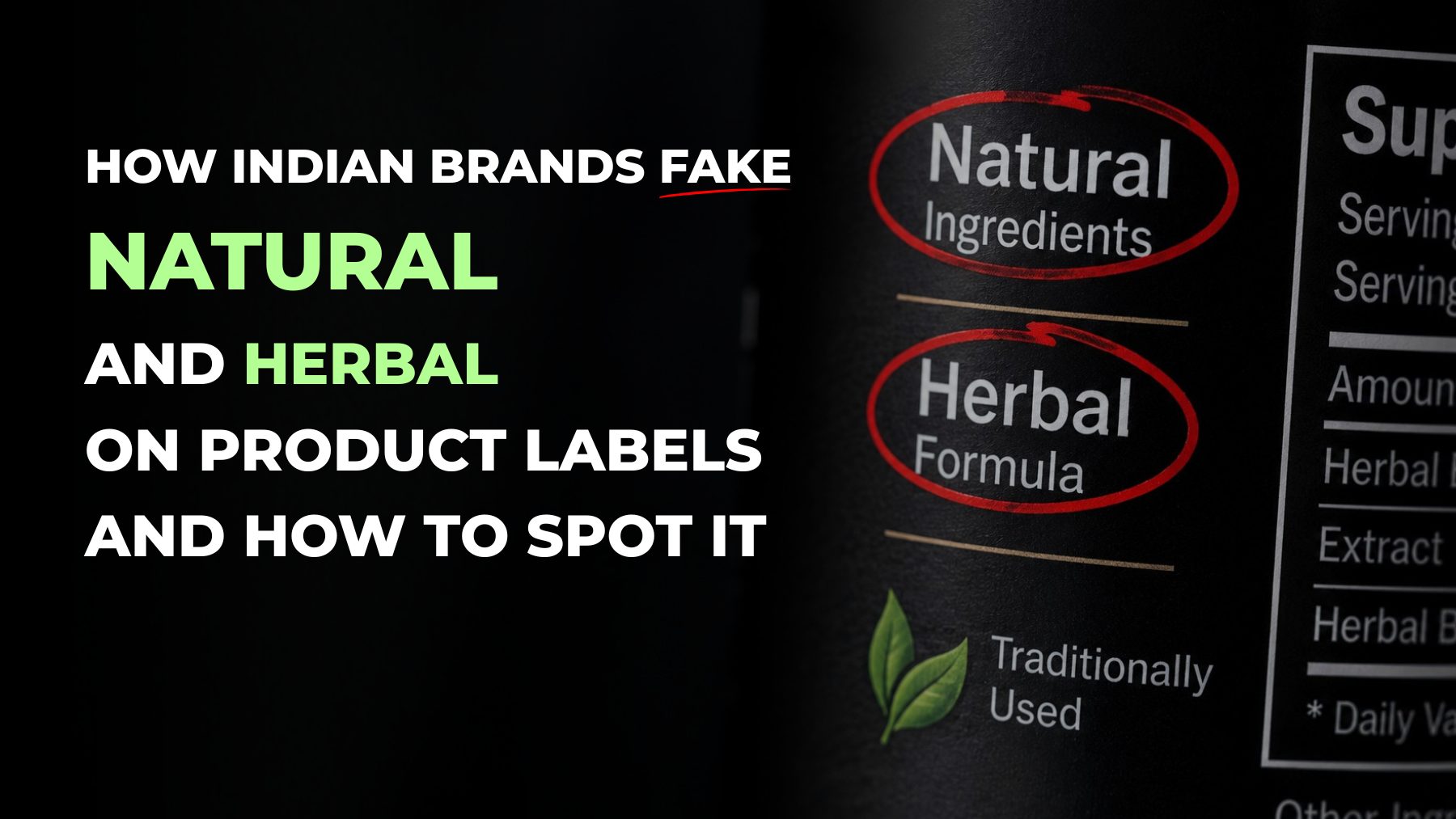
Pick up almost any personal care or food product in India and you will find at least one of these words on the label: Natural. Herbal. Chemical-free. Pure. Eco-friendly. Toxin-free.
Here is what most consumers do not know: not a single one of these words has a legal definition under Indian food or cosmetic regulations. Any brand can print any of them on any product, without any proof, without any certification, without any consequences.
This is greenwashing. And in India in 2026, it is everywhere.
What Greenwashing Actually Means
Greenwashing is the practice of making a product appear more natural, organic, or environmentally responsible than it actually is — through packaging, language, and imagery rather than actual ingredients or practices.
It is not always outright lying. More often, it is strategic vagueness. A shampoo labelled "with natural ingredients" can contain 95% synthetic chemicals and 5% plant extract and the label is technically true. A food product marketed as "traditional" or "pure" can contain refined sugars, artificial colours, and chemical preservatives. The label implies one thing. The ingredients list tells another story.
India's Central Consumer Protection Authority recognised this problem and issued the Guidelines for Prevention and Regulation of Greenwashing and Misleading Environmental Claims, 2024 (PDF) — which explicitly require that words like "natural," "organic," "sustainable," and "pure" must be backed by verifiable evidence and adequate disclosures. Under the Consumer Protection Act 2019, first-time offenders face fines up to ₹10 lakh. Repeat offenders face up to ₹50 lakh and imprisonment.
The guidelines exist. Enforcement is still catching up. The consumer remains the most effective check on greenwashing — which is why knowing what to look for matters.
The 7 Greenwashing Tactics Used on Indian Product Labels
1. Legally meaningless words
As of May 2026, the following words carry no legal definition or regulatory requirement under Indian food or cosmetic law. Any brand can use them freely:
- "Natural"
- "Herbal"
- "Chemical-free" — this one is particularly misleading. Water is a chemical. Salt is a chemical. Nothing is chemical-free.
- "Pure"
- "Traditional"
- "Farm fresh"
- "Toxin-free"
- "Eco-friendly" (without a recognised third-party certification)
- "Sustainably sourced" (without disclosed evidence)
- "Preservative-free" (unless tested and documented)
None of these require proof. None are audited. None are penalised when false — at least not yet.
2. Ingredient position hiding
Indian food and cosmetic regulations require ingredients to be listed in descending order of concentration — the first ingredient is present in the highest amount, the last in the smallest. Greenwashing brands exploit this by putting the "natural" ingredient prominently in the marketing while burying it at position 15 in the actual ingredients list.
A "neem shampoo" with neem listed as the 14th ingredient is mostly something else with a neem label. A "turmeric face wash" with turmeric listed after five synthetic compounds is not primarily a turmeric product. The front of the pack tells you one story. The ingredients list tells you the truth.
3. Look-alike certification logos
This is one of the most common tactics in Indian personal care. Brands design circular green logos that look like official certification marks — leaf motifs, check marks, earth colours — without being any actual certification. They convey the feeling of third-party validation without having received any.
The only certification marks that carry legal weight for organic products in India are the Jaivik Bharat logo, the India Organic (NPOP) mark, and the PGS-India Organic mark. You can verify any product's certification status on the official Jaivik Bharat portal by searching the brand or product name. If a product claims organic certification but does not appear there — the claim is unverified.
4. "Made with" vs "made from"
"Made with organic ingredients" is not the same as "organic." Under FSSAI regulations, a product can only carry the Jaivik Bharat logo if at least 95% of its agricultural ingredients are certified organic. Below that threshold, a product can say "made with organic ingredients" — which can mean as little as 5% certified organic content. The packaging implies one thing; the regulation permits another.
5. Selective ingredient disclosure
Some Indian cosmetic brands list only selected ingredients on the front-facing panel — the appealing natural ones — while the full ingredients list is printed in small font on the back or bottom. FSSAI regulations require complete ingredients disclosure, but the enforcement of label size and prominence is inconsistent. Always read the full ingredients list, not the highlighted selection.
6. Packaging design as greenwashing
Kraft paper packaging, earthy colours, botanical illustrations, and minimalist design signal "natural" to consumers without the product having to make any actual claim. This is legal and widespread. The packaging aesthetic has become so associated with natural products that brands use it deliberately to create an impression that has nothing to do with what is inside.
This is not inherently fraudulent — a synthetic product can be sold in kraft paper packaging without lying. But it is worth knowing that the aesthetic is a marketing choice, not a quality indicator.
7. Expired or irrelevant certifications
Some brands carry certification logos from certifications that have since expired, been withdrawn, or that do not apply to the specific product being sold. An organic certification for a brand's farming operations does not automatically extend to processed products made from that farm's output. Always check that the certification applies to the specific product, not just the company generally.
The Food Aisle vs The Personal Care Aisle — Different Rules
It is worth understanding that food products and personal care products in India are regulated differently — and greenwashing patterns differ accordingly.
Food products: Covered under FSSAI regulations. "Organic" claims on food products require NPOP or PGS-India certification and the Jaivik Bharat logo. The framework exists and is relatively specific. The gap is enforcement and consumer awareness. Our guide on how to verify organic certification in India covers exactly what to look for on food labels.
Personal care products (shampoo, soap, skincare, hair oil): Covered under the Drugs and Cosmetics Act. "Natural" and "herbal" claims on cosmetics have no specific regulatory framework requiring substantiation. The CCPA Greenwashing Guidelines 2024 apply broadly, but cosmetic-specific certification is limited. The Ecocert COSMOS Organic standard and Leaping Bunny cruelty-free certification are the most credible third-party marks for natural personal care — but neither is widely adopted by Indian brands. This is where greenwashing is most rampant and least regulated.
How to Read Any Indian Product Label in 60 Seconds
Here is a practical checklist for any product claiming to be natural, organic, or chemical-free:
- Ignore the front of the pack entirely. Marketing is on the front. Information is on the back.
- Check the FSSAI licence number. Mandatory on all packaged food. Mandatory on cosmetics under the Drugs and Cosmetics Act. Absence means non-compliance — regardless of any other claim.
- Read the full ingredients list. Find the "natural" ingredient they are promoting. Where does it appear? If it is below position 5, the product is primarily something else.
- Check for the Jaivik Bharat logo on any food product claiming to be organic. No logo = unverified organic claim. Full stop.
- For personal care: Look for Ecocert COSMOS Organic, USDA Organic, or Leaping Bunny as the most credible third-party marks. A circular green logo you have never seen before is probably not a real certification.
- Search on the Jaivik Bharat portal for any food brand claiming organic status. 30 seconds to verify.
- Ignore: "natural," "herbal," "chemical-free," "pure," "traditional," "farm fresh." These mean nothing legally.
Why PureStora Was Built Around This Problem
Every product on PureStora is verified for FSSAI compliance and, where applicable, valid organic certification — before it goes live on the platform. This is not a marketing claim. It is the operational standard.
Most Indian online marketplaces list products based on seller-submitted information. A seller can write "certified organic" in their product description without any certification — and the platform has no obligation to verify it before the product goes live. That is the system PureStora was designed to replace.
When you buy on PureStora, the certification check has already been done. The Jaivik Bharat status has been confirmed. The FSSAI licence has been verified. You are not the last line of defence — we are.
Browse verified health and wellness products and certified personal care products — every listing has been checked before it appears.
The Bigger Picture
Greenwashing is not a minor annoyance. It has real consequences.
When a consumer buys a "chemical-free" shampoo that contains parabens and sulphates, they are paying a premium for a false promise — and continuing to use ingredients they were trying to avoid. When a family buys "organic" spices from an uncertified source to protect their children from pesticide exposure, they may be getting conventional spices in organic packaging. When someone switches to a "natural" personal care brand based on marketing without checking ingredients, they may be making no meaningful change to their health at all.
The money flows to the brands that are best at creating the appearance of being natural. The brands that are actually doing the work — getting certified, submitting to audits, using real ingredients — compete on an uneven playing field because certification costs money and marketing costs less. Better consumer awareness is one of the few things that changes this dynamic.
Reading the back of the pack takes 30 seconds. It is the single most powerful consumer action available.
This article reflects publicly available regulatory information as of May 2026. Indian regulations evolve — always verify current certification status on the official Jaivik Bharat portal for food products. For personal care claims, check the full ingredients list and third-party certifications directly.
