
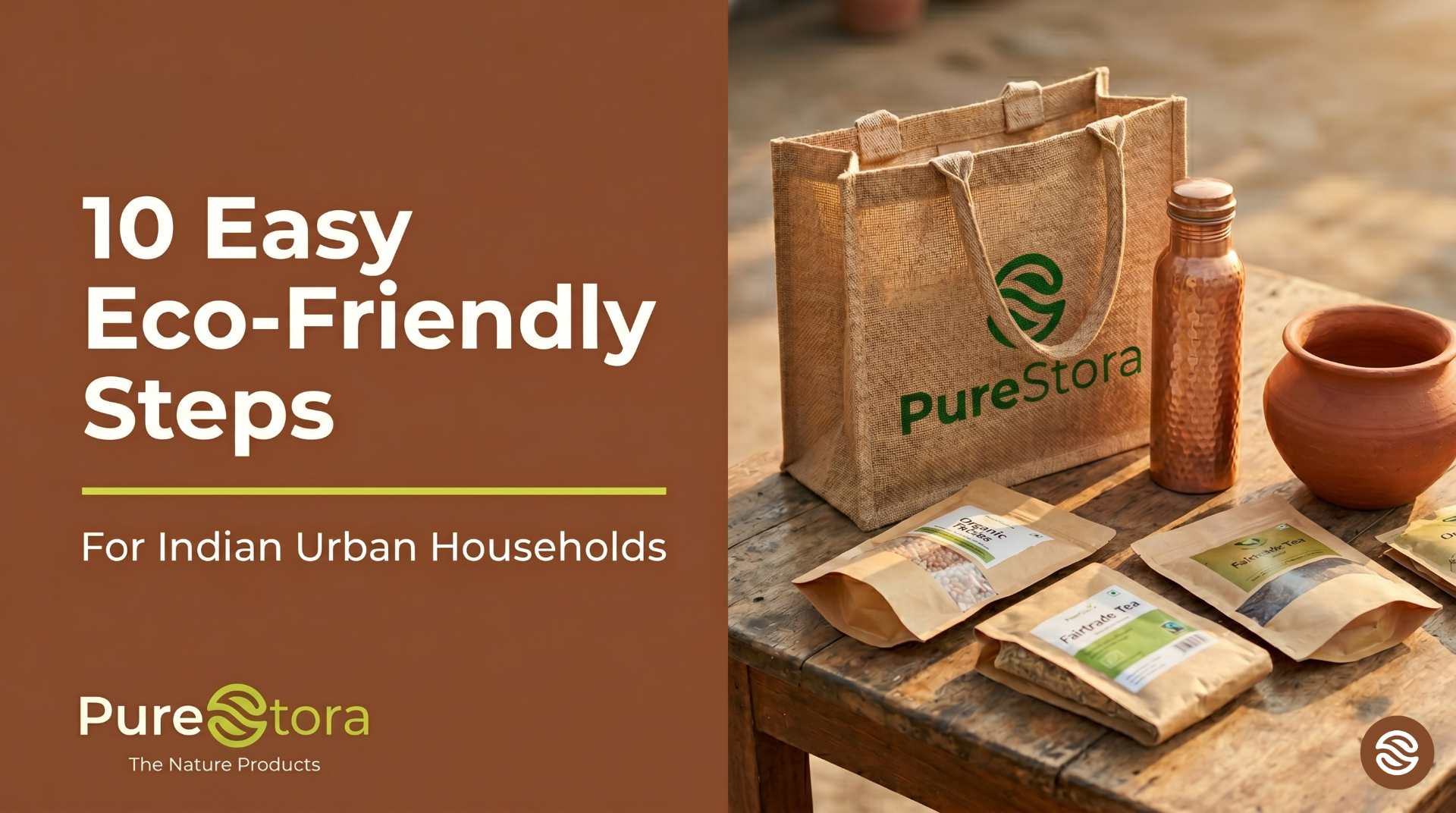
Most eco-friendly guides assume you have a terrace garden, unlimited time, and the patience to overhaul your entire household in a weekend. If you live in a 2BHK apartment in Hyderabad, Bengaluru, or any Indian metro — working full time, managing a family, ordering groceries on Blinkit — this guide is for you. These 10 steps are specifically chosen for Indian urban conditions. None require a garden. None require a weekend. Each is one decision, made once, that keeps paying off. PureStora's natural home essentials range covers the product switches in several of these steps — each vendor verified before listing.
One rule before you start: Pick one step. Do only that one for two weeks until it becomes automatic. Then add the next. The fastest way to fail at sustainable living is trying to do all 10 at once.
Step 1 — Switch Your Grocery Bag (Today, Zero Cost)
Hang a cloth jhola or jute bag by your front door right now. Every time you leave for the market or kirana store, grab it. That is the entire habit. One bag, always at the door.
This single switch eliminates 2–4 plastic bags per grocery trip. At three trips a week that is over 500 plastic bags per year from one household. No cost involved if you repurpose an old cloth bag or cotton tote you already own.
Indian-specific tip: Most kirana store owners are happy to weigh loose grains, pulses, and spices directly into your container. You were not supposed to need a plastic bag for those — that habit came with supermarket culture, not Indian grocery culture.
Step 2 — Replace Your Toothbrush With Bamboo (Next Time It Needs Replacing)
Do not throw away your current toothbrush. When it needs replacing — typically every 3 months — buy a bamboo toothbrush instead. Identical function. The handle is compostable. Cost is ₹50–150, comparable to a regular plastic toothbrush.
One decision made once every 3 months. No daily habit change required. This is what "start where you are" actually looks like.
Step 3 — Switch Your Cooking Oil to Cold-Pressed
The next time your cooking oil runs out, buy cold-pressed groundnut, sesame, or coconut oil instead of refined. Cold-pressed oil skips the hexane solvent extraction and high-temperature bleaching that refined oil goes through. It retains natural flavour and nutritional value.
This is one switch — the same purchase decision made differently — that affects every meal your family eats. For certified organic cold-pressed oils, browse PureStora's organic food and grocery range.
Step 4 — Start Composting Food Scraps (Even Without a Garden)
Vegetable peels, fruit scraps, tea leaves, coffee grounds, eggshells — these make up 50–60% of household waste in India. All of it can be composted in a balcony composter or khamba (a clay pot stacking system designed specifically for Indian apartments).
A properly managed balcony composter is odourless. It takes 45–60 days to produce usable compost. The resulting compost feeds balcony plants or can be shared with your RWA's green space.
For a detailed guide on how composting works in Indian urban apartments — including the khamba system and the kabadiwala for dry waste — see our complete zero-waste lifestyle guide for India.
Step 5 — Choose Organic Spices (Same Purchase, Different Brand)
Spices are the highest-priority organic switch in an Indian kitchen — consumed daily in concentrated powdered form with no ability to wash away residue. The switch from conventional to certified organic spices costs 30–60% more but affects every meal you cook.
This is not a new purchase or a new habit. It is choosing differently the next time you buy turmeric, coriander, or cumin. Look for the Jaivik Bharat or India Organic mark on the packet.
Step 6 — Replace One Cleaning Product With a Natural Alternative
Pick one cleaning product — your bathroom surface cleaner or kitchen degreaser — and replace it with a neem-based or citric acid alternative when it runs out. One replacement at a time. This is how you transition your cleaning products over six months without a dramatic overhaul.
Conventional cleaning sprays release VOCs (Volatile Organic Compounds) into your indoor air. In a sealed, air-conditioned apartment, these accumulate. Neem-based cleaners work effectively and without the synthetic chemical load.
Step 7 — Switch to a Steel or Copper Water Bottle
One stainless steel or copper water bottle eliminates roughly 500 single-use plastic bottles per person per year. The bottle costs ₹300–800 and lasts a decade. Traditional Indian households have used copper and steel water vessels for generations — this is recovery, not revolution.
If you have children, make this the first switch for them. Children's plastic water bottles are used daily and heated in lunchboxes — conditions where plastic leaching is highest.
Step 8 — Use the Kabadiwala Actively
Most urban Indian households already have a kabadiwala relationship but use it inconsistently. Make it a system: keep a dedicated dry-waste bag in your kitchen for paper, cardboard, metal, glass, and plastic bottles (PET — code 1). Call your kabadiwala when it is full.
The kabadiwala network is one of the world's most efficient informal recycling systems. Using it actively means your dry recyclables enter the recycling supply chain rather than going to landfill. Zero cost. No new habit — just formalising one you already have.
Step 9 — Switch to Organic Dal for Daily Cooking
Dal is cooked twice a day in most Indian households — making it the highest-volume food in the Indian diet and therefore the most impactful item to switch to organic. The pesticide residue difference between conventional and certified organic pulses is cumulative over daily consumption.
The switch is simple: next time you buy masoor, moong, or toor dal, buy the certified organic version. Look for FSSAI Organic or India Organic mark on the packet. The price premium is typically 20–30% — meaningful but manageable for a daily staple that forms the nutritional foundation of most Indian vegetarian diets.
Step 10 — Choose One Festival Gift This Year That Is Genuinely Certified
The next time you are buying a festival gift — Diwali, Raksha Bandhan, a housewarming — choose one that is genuinely certified organic or genuinely zero-waste. One gift. One occasion. Not every gift, every occasion.
This matters because it normalises the choice in your social circle. When someone receives an organic dry fruit hamper or a reusable copper bottle as a gift instead of a thermocol-tray mithai box, it creates a conversation. That conversation is how the shift spreads beyond your household. For ideas on what to look for and how to verify genuine eco-friendly gifts, see our guide on eco-friendly gifts for Indian festivals.
The One Rule That Makes All 10 Work
Progress over perfection. An Indian urban household that eliminates 500 plastic bags per year, composts its kitchen scraps, and switched its cooking oil and daily dal to certified organic is doing more than one that buys an entire "eco-friendly kit" from a greenwashing brand and calls it done.
The steps above are not a checklist to complete in a weekend. They are a sequence — one decision at a time, made when the natural moment arrives (when the toothbrush needs replacing, when the oil runs out, when the next festival approaches). Sustainable living in India is not a dramatic lifestyle overhaul. It is the quiet accumulation of better decisions, each made once, that compounds over time.
Frequently Asked Questions
Which eco-friendly step should an Indian urban household start with first?
Start with the cloth bag — it costs nothing, requires no new purchase, and immediately eliminates 2–4 plastic bags per grocery trip. Hang it by the door today. Once that is automatic (about two weeks), add the next step. Starting with the lowest-friction habit builds the momentum that makes the rest possible.
Is composting really practical in an Indian apartment without a balcony garden?
Yes — a khamba (clay pot composter) or balcony compost bin works in any outdoor space including a small balcony. It is odourless when managed correctly with a 3:1 ratio of dry to wet material. The compost produced feeds potted plants or can be shared with your building's RWA green area. See our full guide on zero-waste living in India for step-by-step composting instructions.
Are these eco-friendly swaps more expensive than conventional options?
Some are slightly more expensive upfront — certified organic dal costs 20–30% more, cold-pressed oil costs more than refined. Others have no cost difference (cloth bag, kabadiwala use) or save money long-term (steel water bottle replacing 500 single-use bottles per year, bamboo toothbrush comparable in cost to plastic). The framing that eco-friendly always costs more is not accurate when you look at total cost over time.
How do I verify if a product claiming to be organic or eco-friendly is genuine?
For food products: look for the Jaivik Bharat logo or India Organic mark on the individual product packaging — not just in the brand name or product description. For eco-friendly non-food products: read the material description and look for specific certifications (GOTS for textiles, specific material claims for bamboo or stainless steel). "Natural" and "eco-friendly" without further specification are unregulated marketing terms. Our full guide on how to identify genuine organic products in India covers the verification process step by step.
Conclusion
Ten steps. One at a time. Each one made at the natural moment — when something runs out, when a purchase needs to be made, when the next festival approaches. That is all sustainable living actually requires from a busy Indian urban household. No garden, no weekend overhaul, no perfection required. Start with the cloth bag at the door. Everything else follows from there.
Disclaimer: This article is for general informational purposes only. Product certifications should be verified on individual packaging before purchase.
